The Map Is Not The Territory
A short video I created as part of my graduating work for the MA in Engaged Humanities and the Creative Life I recently completed at Pacifica Graduate Institute.
Two Essays About Finding Home in The Wizard of Oz
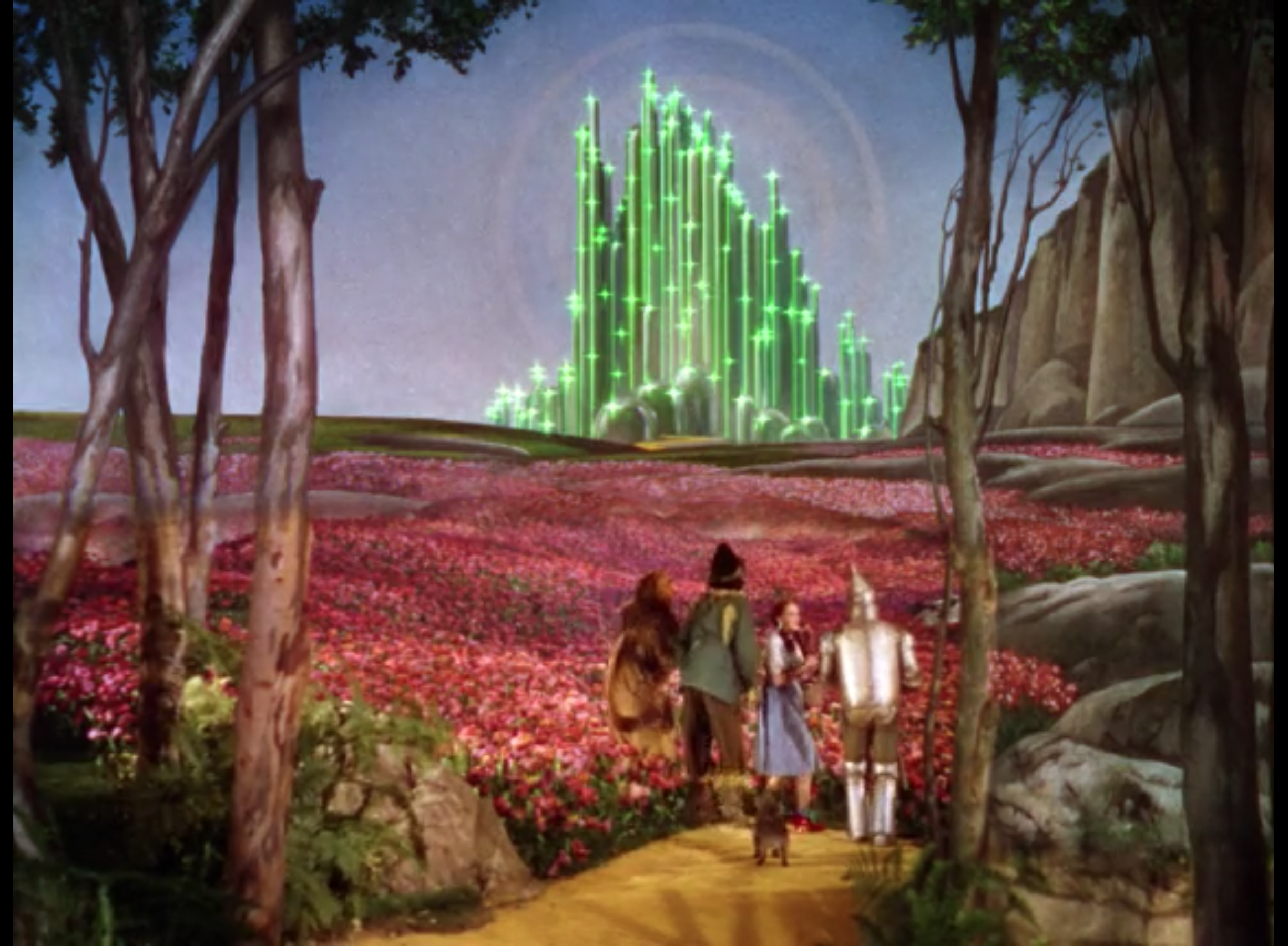
The Emerald City.
The Road Home, The Road To Self: Archetypal Anarchy in The Wizard of Oz
The iconic 1939 film The Wizard of Oz comes with a remarkable statistic attached: it is the most watched film of all time. This is in part due to its frequent appearance on broadcast networks worldwide but scholars believe the film possesses qualities which capture the imagination of the public in unique ways making it an always profitable choice for repeated broadcasting. Elements from this film have succeeded in penetrating cultural dimensions far and wide, necessitating an explanation for its unparalleled popularity. This explanation has been taken up by a number of writers and scholars and some of these will be explored in this essay. Observations about what appears to be a clear archetypal message in the film along with some of the differences with L. Frank Baum’s book The Wonderful Wizard of Oz (1900) will be offered and the salient parts of the film will receive a thorough going over.
The establishing shot of The Wizard of Oz is of a dirt road lined with uneven-looking low wooden fences. The road leads to the horizon where nothing is visible but the inevitable meeting of earth and sky. There is about this road an impression of dilapidated orderliness, a sense that the area has gone to seed, as it were, and this feeling is reinforced by the sepia-toned black and white photography. Dorothy bursts onto this drab and uninspiring dirt road accompanied by her little Cairn Terrier, the infamous Toto. She is deeply distressed and looks back over her shoulder frequently as though being chased by demons. Her dark fiery eyes look back with great emotion, her fear palpable, as she checks to see if Toto is all right. Dorothy and Toto then run home to the Kansas farm where Dorothy lives with her Aunt Em and her Uncle Henry. We now discover the reason for the agitation: Toto has been hit on the back with a rake by Miss Gulch, the wealthy neighbor. Toto’s life is in serious jeopardy but Dorothy’s relatives are too busy to listen for they have troubles of their own. The incubator has broken and the little chicks therein are threatened with imminent death and must be quickly counted and relocated. The action takes place with rapidity and Dorothy is clearly beside herself with worry. But Aunt Em believes that Dorothy is, as usual, getting herself “all worked up about nothing” and encourages her to stay out of everyone’s way someplace “where there is no trouble.”
This brings us to one of the most iconic moments in the film when Dorothy sings “Over The Rainbow.” Even after repeated viewings, this relatively short piece of film history casts a powerful emotional spell and pulls at the heartstrings, often bringing tears to the eyes of viewers. The message of the song is one of hope and longing. The beauty of Judy Garland’s unbiased voice, the innocence of the words, the gentle way they are imparted, and the simplicity and honesty of the melody all combine with such force that one is easily carried away into a dream of longing scarcely imagined before. Salman Rushdie believes that what Judy Garland “embodies with the purity of an archetype, is the human dream of leaving . . . .‘Over The Rainbow’ is . . . the anthem of all the world’s migrants . . . . It is a grand paean to the Uprooted Self, a hymn—the hymn—to Elsewhere” (Rushdie, 1992, p. 23 ). The song asks a simple question: Why? If happiness is possible, why can’t I feel it? It functions as an incantation and marks the beginning of the weird and elusive rite of passage that follows.
Despite Aunt Em’s assertion that Dorothy is just imagining things, the evil Miss Gulch does indeed materialize and she comes armed with a notice from the sheriff giving her permission to take the dog away to be “destroyed.” She forcefully threatens the withered aunt and uncle reminding them not to go “against the law.” Toto is stuffed in a basket and Dorothy, devastated, runs to her room in tears. This episode marks an encounter with the film’s ongoing interest in portraying the genuine inadequacy of adults and with the idea that belief in oneself can save the day. That Aunt Em and Uncle Henry are of no help is alluded to earlier, but their inability to save Toto from Miss Gulch brings this fact home in a final way, setting the stage for Dorothy’s upcoming travels. Clearly, she must take matters into her own hands for her parents are not around (no explanation is ever given for why Dorothy lives with her aunt and uncle) and her guardians are old, gray, and ineffectual.
After Toto manages to escape from Miss Gulch’s basket and returns to Dorothy, the pair run away. On the road not far from home, Dorothy happens upon an itinerant fortune teller called Professor Marvel who lives in a ditch under a bridge. Although well-meaning, he is nevertheless a charlatan, a sleight-of-hand trickster, but Dorothy, in her innocence, does not know it. She trusts his word completely and this empowers Professor Marvel to use his fortune telling skills to construct a woeful story about Aunt Em’s broken heart. Deeply concerned about her Aunt, Dorothy resolves to return home at once. Here we reach a crucial difference between the film and the book. In the original text, Dorothy remains at home, there is no threat from Miss Gulch (indeed, there is no Miss Gulch at all), and the tornado that carries Dorothy to Oz simply comes out of nowhere. In the first act of the film, however, a series of existential threats compel Dorothy to make a disturbing wish (for one so young) to be somewhere else, and then to run away from home altogether. Yet before anything meaningful can be accomplished, she must turn right back around, or, at the very least, quickly recalibrate her wish for “elsewhere” into a burning desire to be back “home.”
In his 2014 essay “There’s No Place Like Home: An American Koan,” David L. Smith argues that this moment in the film is what provides its penetrating archetypal dimension. In the book, no real emphasis is placed on the idea of home. Everything happens in episodic and often pointless meandering storylines. On the contrary, in the film, everything is about getting back home and this urgent need of Dorothy’s is established only after the meeting with Professor Marvel. The elusive nature of home, however, gives the idea mythical qualities which capture the imagination. According to Smith, “Home stands not only for the thing you already have but for something you desire, something you never fully possess. It is simultaneously where you are and an ideal for what it would mean to be fully and completely in place” (Smith, 2014, p. 288). Dorothy dreams of a place beyond the rainbow where there is no trouble and sets out to find it, only to discover, moments later, that she also wants and needs the thing she already has, the same Kansas home with all its inadequacies and troubles. In this sense, Dorothy’s dilemma perhaps symbolizes the dilemma of all Americans and, as Salman Rushdie claims, all migrants; Americans are, after all, the inheritors of a completely immigrant cultural heritage. According to Smith, “‘Home’ for the immigrant is both here and elsewhere. It is the immediate reality one longs to embrace and also the past or future possibility that keeps one from feeling fully in place, wherever one is” (Smith, 2014, p. 288). But something happens before Dorothy can return home and this something, namely, the tornado that carries her to Oz, is a larger than life symbol which states, unequivocally, that the home Dorothy seeks is more than just what normal life can offer her. A profound psychic transformation must occur within, for life in Kansas with her old and gray relatives is now unbearable. Somehow, over the rainbow and Kanas must merge, and perhaps this can only happen through a spiritual quest, something she must find out for herself since the grown-ups are useless. Dorothy discovers that “something is lacking” in her current state and she “imagines . . . that something remote will make up for this lack—that real life is elsewhere” (Smith, 2014, p. 289).
Another important distinction between the film and the book is the reality of Oz itself. In the book, Dorothy’s house is literally uprooted by the storm and literally transported to Oz, a real place. During the journey there, Dorothy is calm and unafraid and is even able to sleep. In the film, however, Dorothy, caught unawares by the storm, is hit on the head by a window pane and knocked out of consciousness. The film makes it clear at this point that she dreams or hallucinates an elaborate journey through Oz where people who inhabit her real life back in Kansas are cast as surreal otherworldly entities such as a Scarecrow, a Tin Man, a Cowardly Lion, a Wicked Witch, and an all-powerful Wizard. The fact that the journey to Oz is a dream is an important function of the film’s message according to David C. Downing. In his 1984 essay “Waiting for Godoz: A Post-Nasal Deconstruction of The Wizard of Oz,” Downing claims that the film is “one of the most devastating exposes of institutional religion ever to reach the screen” (p. 28) and it is precisely the dreaming Dorothy that evidences his claim. In Downing’s view, the unreal nature of Oz and its unfruitful wizard symbolize the unreal nature of religious practice and its unfruitful pointlessness. The “central thesis of the film” is, according to Downing, “that the metaphysical realm posited by religious devotees is nothing more than a projection of the physical realm, a place in which psychic deficiencies may be remedied and hidden longings may be fulfilled” (Downing, 1984, p. 28). Indeed, Downing points to Dorothy’s evasion of reality to strengthen his claim that the film mocks the escapism inherent in the religious worldview, with its heavenly, transcendent God who lives in heaven or, as Dorothy calls it, “over the rainbow.” In Oz, Dorothy is encouraged to follow the highly unrealistic, cartoonish Yellow Brick Road so that a godlike figure, none other than the wizard himself, can tell her how to get back home. Along the way, Dorothy acquires three companions, who “join her on her Grail-like quest, each in hopes of conquering some emptiness within” (Downing, 1984, p. 29). After some colorful adventures, the quartet finally discover “the wizard to be a fraud, a humbug, a genial old gentleman quite literally projected to larger-than-life proportions” who is nevertheless able to “certify to each one what he gained by believing in the quest” (Downing, 1984, p. 29) even as he remains unable to fulfill Dorothy’s and the film’s pivotal existential requirement. It is Glinda, the Good Witch of the North, who ultimately fulfills that requirement by soliciting from Dorothy the most enigmatic lines in the entire film, and this, in turn, brings us back to the paradox of home.
As mentioned above, the film opens with a dirt road. Much of the subsequent adventures take place along the Yellow Brick Road. Both roads are shown to be surrounded on either side by land that is mostly irrelevant to the story. The Road is visually highlighted and indicated as the primary means of travel; it, therefore, takes on its own archetypal dimension. “Just follow the Yellow Brick Road,” intones Glinda at the onset of the journey, implying that following the road will yield answers. In other words, the quest for home is shown to require a road, a means of travel, and a direction. Dorothy never actually leaves Kansas but rather dreams an elaborate dream from the comfort of her own bed, yet she somehow manages to undertake a real journey. What, then, is the nature of the road she travels upon?
After Dorothy’s three companions are “certified” by the Wizard, and the Wizard flies off without her in his balloon, Glinda arrives to undertake an accounting on Dorothy’s behalf and to stand witness to her inherent knowledge. Dorothy, she says, has had the ability to get back home the entire time, she just “had to learn it for herself.” When asked what it is she has learned, Dorothy says: “If I ever go looking for my heart’s desire again, I won’t look any further than my own backyard. Because if it isn’t there, I never really lost it, to begin with.” And, lo and behold, with this quizzical pronouncement, Dorothy is finally able to wake up from the dream, the elusive words “there’s no place like home” accompanying her on the road back to consciousness. There is a paradox contained in this ending and in the very statement “there’s no place like home” to which Smith convincingly points. That infamous statement contains within it a negative implication which says that there is not, in fact, any “place” like home; home is not a place that actually exists, especially not for the immigrant, and all humans are immigrants after all, for we are all here on this planet for a short time. We do not really know where we come from nor do any of us really know where we go after we die. We are all cosmic migrants on planet Earth just as many of us are human immigrants living in territories unknown. We have within us both an acute sense of belonging to our lives as human beings and a sense of not knowing who or what we truly are or why were are here. Home, then, is an elusive double entity, something we both desire and lack, and on this road home, our only guiding light is our heart and its desires. Dorothy says that what her heart desires ought to be right there in her “own backyard” and if it is not, then how can it be lost? How, indeed? Smith says, “What is at stake in the desire for home is something immediate and inalienable, however elusive it may feel. Life, self, and the world are givens, not remote ideals to be attained” (Smith, 2014, p. 290). As has been pointed out, the film seems to say that no one else can tell us how to get home, that we must learn it for ourselves, but that this knowledge is implicitly our own from the beginning. While people in positions of power will try to claim knowledge of the way, ultimately one must travel an interior road, integrating the diverging, contradictory, and paradoxical aspects of life into something immanent and whole. “It is precisely because home is a wholeness implicit in our immediate circumstances that it is not comparable to any other place” (Smith, 2014, p. 290). Indeed, it is this unbound yet inherent nature of home that allows it to be both the desire of our hearts and its fulfillment. “Because home” is “no place, and not a thing to be attained, it is an inalienable possession” (Smith, 2014, p. 291) and therefore cannot be lost.
Another significant element of the film is its insistence on the wonderfulness of the wizard, this claim is repeatedly expressed in the song “We’re Off to See the Wizard” in which the wizard is declared a wizard strictly because of the wonderful things he does:
The Wizard of Oz is one because
Because, because, because, because, because
Because of the wonderful things he does
We're off to see the Wizard
The Wonderful Wizard of Oz
Indeed, the film is filled with images of wonder and one can only imagine the reaction of viewers back in 1939. The production is said to have cost nearly three million dollars and apparently, no expense was spared. Like many other popular children’s books turned into film, The Wizard of Oz contains highly surrealist imagery that show the protagonist involved in adventures with fantastical creatures such as talking trees, flying monkeys, good and bad witches, munchkins, horses that change color, magical ruby slippers, flying houses, and powerful wizards who live in emerald cities. In his introduction to The Shadow and Its Shadow: Surrealist Writings on the Cinema (2000), Paul Hammond says that what the Surrealists desired was to “follow the exemplary ‘trajectory of the dream’ as it revisioned daily life” for they believed that “only by reforging links with . . . the ‘primal mind’—the mind at one with nature, expressing itself through the imaginary—could the real be fully comprehended and thus recast according to human need” (Hammond, 2000, p. vii). As a visual text on the power of wonder-full images, The Wizard of Oz undertakes this surrealist maxim with considerable “vim and voive,” for as has already been shown, the entire adventure is a faithful following of a dream road, that “exemplary trajectory” of Dorothy’s dream of a homeward journey. The film shows how the reality of waking life alone is insufficient for the task of living a fulfilled life and points to what Silke Dettmers, calls “the necessity of wonder” as a means of travel: a mystical yellow brick road one may traverse in order to integrate the “primal mind” with the “real.” Throughout the film, Dorothy’s evocative eyes are like infinitely deep searchlights expressing pure amazement (along with pleasure, pain, confusion, joy, and horror) at witnessing such dramatic imaginal wonders. Dettmers (2007) says that “staring is the beginning of getting to know the world” (p. 2) and so it is through staring that Dorothy registers the profound wonders of her surroundings as they pour into her psyche. “Wonder, ‘the first of all the passions,’ prioritizes the senses, it is populated by images” and is a state “before words and reason” (p. 4). Accordingly, “wonder is the opposite of proof,” the proof that is sought by the logical mind of reason, the mind that cannot allow anything to exist unreasonably. For Dorothy to escape what is a most unsatisfactory existence in Kansas, she must overcome the boundaries set upon her by the dull, gray world she inhabits. This task she duly undertakes by losing consciousness and traveling straight to the unconscious where dreams, images, and the wonderful are given free reign to activate “the spaces between,” opening up “a multitude of possibilities” rather than just the one presented to her in Kansas: grow old, live without wonder, and die. The Wizard of Oz, like Surrealism, unequivocally rejects the world where one cannot “go against the law” and instead proceeds by “privileging . . . the poetic imagination as the keystone, the binding agent, of authentic understanding” (Hammond, 2000, p. 3).
The film, therefore, proposes the adoption of an anarchic attitude toward religion, parentage, heritage, and place; this is why it is so popular. It tells us that we do not need institutions or people in powerful places to give us what we seek for we already possess everything. Indeed, it goes one step further, calling into question the authority we ourselves give to these same institutions and powerful individuals. It wonders why our teachers and leaders adorn themselves in cloaks of power and authority when they are equipped with nothing more than sleight-of-hand skulduggery and puffs of ineffectual smoke. The Wizard of Oz seeks to return power to the individual and questions the validity of the spiritual quest, the mono-myth of the heroic journey, as the only viable approach to life. It shows us that the road home is the inherent and given birthright which we all have unimpeded access to every evening when we lay down our heads and go to sleep, and even explains why there are so many drugs on the market trying to keep people apart from their inner selves. It reminds its millions and millions of viewers that the poetic imagination is the liberating and anarchic road to self, the true road home, and all one need do is follow it.
References
Downing, D.C. (1984). Waiting for Godoz: a post-nasal deconstruction of The Wizard of Oz. Christianity and Literature, 33(2), 28-30.
Dettmers, S. (2007). On the necessity of wonder. Papers of Surrealism Journal, Vol. 6., Retrieved from http://www.surrealismcentre.ac.uk/
Hammond, P. (2000). The shadow and its shadow: Surrealist writings on the cinema. San Francisco: City Lights Publishers
Rushdie, S. (1992). The Wizard of Oz. London: UK. BFI Publishing.
Smith, D.L. (2014). “There’s no place like home”: An American koan. Journal of Religion & Popular Culture, 26 (3), 287-292. doi: 10.3138/irpc.26.3.287
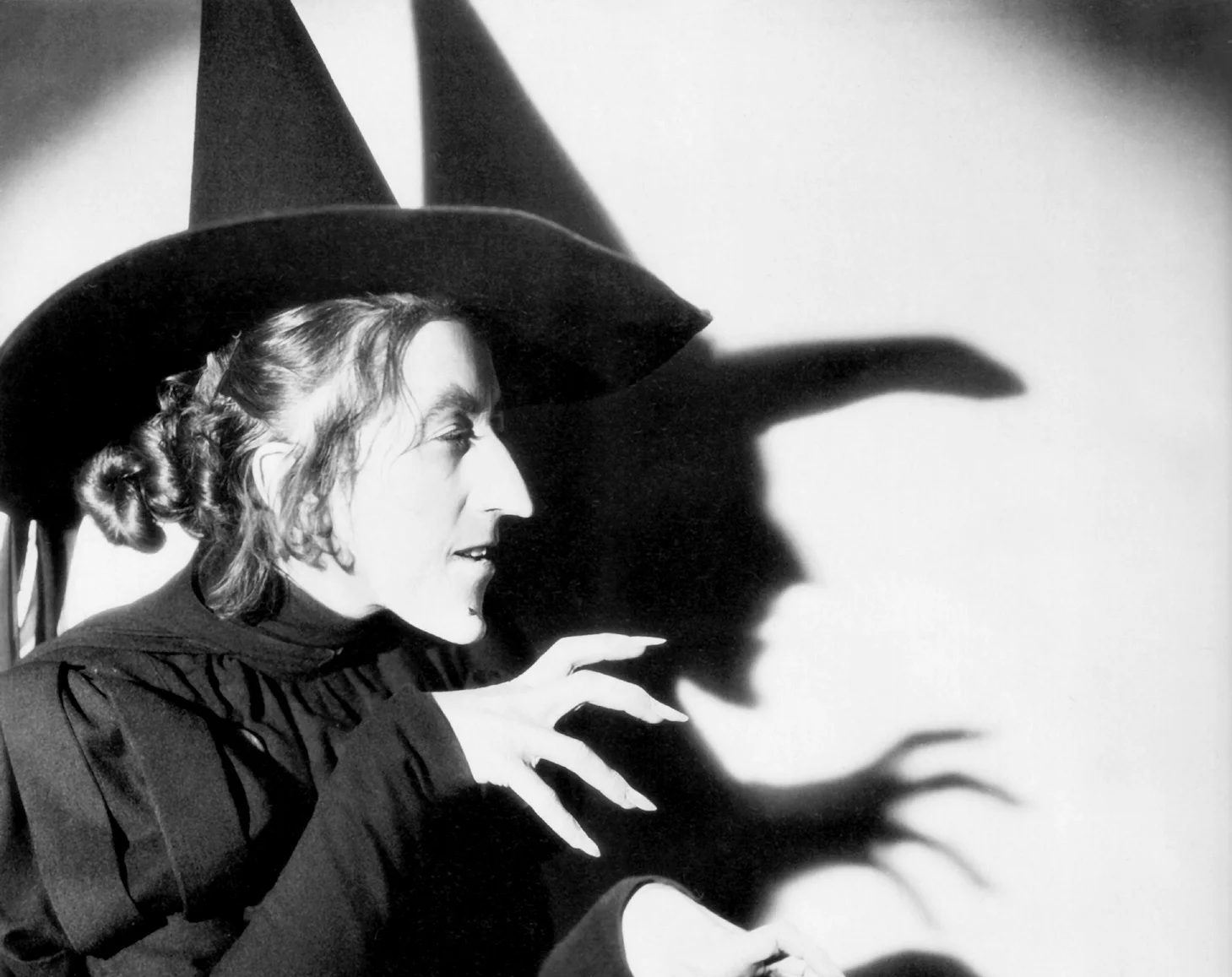
Epic photo of Margaret Hamilton as The Wicked Witch of the West.
Out Of The Woods: Hestia, Dorothy, and the Mythic Quest for Home
Part 1: There’s No Place Like Home
For many people, both the idea and the physical reality of home are enshrined in perpetual mystery. Somehow, for them, home is never truly present, even as they live in one. Constant moving, often across oceans and continents, means that there is no ancestral place, no home base, and no continuity. For this type of person, lack of an ancestral home sets the stage for a life-long quest. Something profoundly important is missing and longed for; it must be regained. A closer look into the nature of this quest, however, shows that it goes beyond the individual. Longing for home appears to be a broader, almost universal theme, one that is echoed across cultures throughout history, an idea that often transcends physical parameters or attributes. Indeed, under careful scrutiny, “home” becomes an elusive and unattainable mystery that must nevertheless be sought and found. Yet, that it shall be found, or that it even exists, is never guaranteed, which makes an ongoing quest for a literal home potentially problematic. Looking at the 1939 film, The Wizard of Oz, and the myth of Hestia and her relationship to the home, this essay will attempt to solve the riddle of place. Dorothy claims that “there’s no place like home,” while others have said that “home is where the heart is.” An examination of the truth of each claim will show if Home is something that can, indeed, be lost and found.
L. Frank Baum’s famous book, The Wonderful Wizard of Oz, differs from the movie in many ways but that is not the subject of this paper. Here, the focus will be on the film version. In the iconic film, a simple story is laid out and we, the viewers, follow Dorothy as she sets out on a magical journey which, paradoxically, begins with her running away from home. Dorothy is a young girl living in Kansas with her Aunt Em and her Uncle Henry during what appears to be the Great Depression. Her aunt and uncle are old and gray, the farm is dusty, and the landscape is flat, barren, and lifeless. As the film begins, we see that Dorothy’s beloved and loyal companion, Toto, is threatened with euthanasia by the evil village schoolteacher and Aunt Em and Uncle Henry are powerless to stop it from happening. Dorothy decides to run away but before she gets very far, she meets Professor Marvel, an itinerant fortune teller, who, perceiving Dorothy’s youth and innocence, uses his “powers” to show her an image of Aunt Em in deep distress. This encounter turns Dorothy around to face home again but before she can fully return, a tornado comes between herself and her family, transporting Dorothy and her house to the magical Land of Oz. Once there, Dorothy embarks on a classic heroic quest which inevitably leads her back home.
In his 2014 essay, “There’s No Place Like Home: An American Koan,” David L. Smith argues that this pre-quest meeting with Professor Marvel is the most important moment in Dorothy’s story, for it alters the mystical locus of her quest from “somewhere over the rainbow” back towards “home” (p. 289). But home is a concept that eludes, for surely Dorothy does not seek the actual home in the depressed Kansas farm where her dog’s life remains in danger, nor does she seek her Aunt and Uncle’s withered and wizened lifestyle. What she seeks is what many of us seek, and what Smith calls an “existential tautology,” for “Dorothy longs for a home that is both immediate and remote, at once in her own backyard and over the rainbow” (p. 287). This is shown in the remarkable speed with which she switches direction. Indeed, Dorothy never actually leaves home. She simply takes a stroll down the lane and turns right back around again. As we see at the end of the film, Dorothy, having lost consciousness during the storm, essentially hallucinates her way through Oz. Her adventure is therefore really an interior one which fits in perfectly with the paradoxical nature of home. Her emphatic claim that “there’s no place like home” has a negative implication, suggesting that there is not, in fact, any “place” like home. Therefore, inherent in the statement is a double meaning which pits a nostalgic and ambiguous desire of the heart against the reality of human existence where such desires are not always fulfilled. As Smith indicates, “‘Home’ stands not only for the thing you already have but for something you desire, something you never fully possess . . . . The given-ness of home is closely shadowed . . . by a sense of displacement” (p. 288) [Italics mine]. This feeling of being split between having and not having is one keenly felt by immigrants and immigrant cultures, to whose milieu Dorothy’s story and American cultural heritage both belong. However, the paradoxical desire for home both “here and elsewhere” is obviously problematic. In it there remains a constant sense that something is lost and a great striving must be continuously in place to retrieve the lost “thing,” creating a perpetual feeling of dissatisfaction. This longing “is intensely present but likely to be shadowed by a nostalgia or an aspiration that simultaneously enriches and discredits the life one lives” (Smith, 2014, p. 288). This problematic yearning necessitates a deeper understanding and realization of the immanence of the self and the inherent nature of home if a never-ending, and ultimately unproductive journey, like the one Dorothy takes, is to be avoided. Dorothy and her companions discover that they were always in possession of the very things they sought, for “each—if only he or she could have known—was always already whole, always already home” (Smith, 2014, p. 290). The great and powerful wizard is, after all, a self-involved used car salesman who only has the power to give them images of things they already possess. The foursome friends circumambulate the inner psychic circle symbolized by Oz, reach the axis mundi, the Emerald City, and “learn for themselves” what they already knew. In the end, the Scarecrow asks,“What have you learned, Dorothy?” and Dorothy, enigmatically, says, “If I ever go looking for my heart’s desire again, I won’t look any further than my own backyard; because if it isn’t there, I never really lost it to begin with.” Here, finally, is the answer to the unproductive longing that haunts the perpetual seeker: whatever there is to find is already there, and if it is not, then how can it be lost? It is a paradox that says, “What is at stake in the desire for home is something immediate and inalienable, however elusive it may feel. Life, self, and the world are givens, not remote ideals to be attained” (Smith, 2014, p. 290). In other words, what we seek is entirely present and intimately our own, even as it oscillates between immanence and remoteness, carrying our hearts hither and thither in great undulating arcs. A heart’s desire is, after all, in perpetual flux, and therefore, where the heart is (the very state of home/heart-ness), is necessarily in motion, multitudinous in scope, and elusive, even as it resides in a fist-sized, compact space.
Part 2: Home is Where The Heart(h) Is
On their 1971 album, Abbey Road, The Beatles point to the paradoxical nature of a heart’s desire and how difficult it is to define or grasp, much less obtain: “Out of college, money spent. See no future, pay no rent. All the money’s gone, nowhere to go. But, Oh! That magic feeling! Nowhere to go.” The universal aspect of this desire for home gives it an archetypal dimension. According to C. G. Jung, archetypes are primordial psychic patterns contained within the collective unconscious and they are busily at work in all our lives. They are responsible for drawing consciousness into being, facilitating the development of form and meaning. Archetypes are themselves formless and can communicate through images most commonly encountered in dreams, myths, and the symbolic imagery found in films, television, and the visual and literary arts. Furthermore, the archetype is autonomous, “it lives of itself . . . it is a life behind consciousness that cannot be completely integrated with it, but from which, on the contrary, consciousness arises” (Jung, 2014, p. 26 [CW 9 pt. 1 para. 57]). In her 2006 doctoral dissertation, Maren Hansen discusses the psychological function of archetypal myths and shows how we can utilize a myth to help us understand the inner workings of the psyche. She says, “We vicariously experience a psychological journey into our unconscious by identifying with a myth, thereby bringing into consciousness some material that was previously unconscious” (Hansen, 2006, p. 63). Greek gods and goddesses are good examples of such myths, and since the concept of home has proved elusive and problematic, it may be useful to hitch a ride on one of these archetypal myths to search for home deep within.
Hestia is the Greek goddess most closely associated with the home and with this interiority of the heart’s desire, where the fire of love has been known to reside. Ginnette Paris says that Hestia, as an archetypal representation of a circular fire, is “the center of the Earth, the center of the home, and our own personal center” (Paris, 1986, p. 168). In Greek homes, the Hestia, or hearth “was the heart of the home, the place of intimacy for the group or family” (Paris, 1986, p. 168). In ancient Greece, this flame of the hearth was considered sacred and eternal, and it was carefully maintained, both at home, and in the city center where it was tended by virgins. The idea seems to be that the center must be tended to and kept warm and alive through careful focus, which is the Latin meaning for Hearth. According to James Hillman, Hestia’s psychological function is “as the centering attention that warms to life all that comes within its radius” (Hillman, 2007, p. 235). Hestia is, therefore, the goddess that brings into focus the fire of necessity and the necessity of fire, the one who embodies the warmth of the heart(h).
What has happened to the one who has lost (the way) home? Where is her heart(h) and where her fire? For the person who lives in a psychic-self-as-home where the fire has died, either because of too much outward movement, or too much giving way, so the centrifugal force of attention can no longer hold the center, “the flame that will re-animate the house must be sought elsewhere” (Paris, 1986, p. 169). This is the central problem of the homeless—the sacred, centering, and continuous fire of love within the heart has died and only through complex rituals, rites, and perhaps even a lifelong quest that takes us “elsewhere” can it possibly be relit. This is exactly the elsewhere Dorothy seeks “over the rainbow,” for in Dorothy’s conscious life, there is nothing but a future of drudgery, dusty old age, and decay. The promise of elsewhere is both the frustrating duality of something remote and its antithesis, an ever-present center, for, again, the warmth and love of Aunt Em remain realities to which Dorothy wants to return, realities that were accessible even before she left. How, then, can we reanimate and embody the flame of the hearth, the heart of our desires, the one we run from and the one we seek? If our efforts continually lead us back to a paradox, then how can we live an embodied life, how can we bring harmony into our midst? The answer is that there is no one correct answer. The reality of human life includes vast psychic dimensions that are perpetually in motion, and the inhabitants of these dimensions seek to live out the many possibilities inherent in a vastly creative primordial soup. There is no tidy answer to the riddle of longing or to the paradox of wanting to be both here and elsewhere. Just as we live an ego consciousness in our daily lives while simultaneously inhabiting infinite realms of unconscious spaces, we desire unimpeded access to our own interior space and we want to discover other worlds and dimensions decidedly outside of and away from that space. To live comfortably within the fiery interior space of the heart-as-home, keeping the Hestia, the focus, clear within the heart, while moving easily through the multivalent dimensions of the world-heart in broader lands “over the rainbow” seems to be the ultimate lesson of The Wizard of Oz. Any search for home is a circular journey back to the center of the heart/self where the message is very simple: “All is well. Tend the fire. Stay focused.” There is no place like home, but home is where your heart is, right now, even when right now includes being “assaulted by the forces of darkness.” So long as the fire is tended, the center will hold. Then, when this sacred focus is achieved, the warmth of the heart(h)’s fire will manage to re-member “a brain . . . a heart . . . a home,” and “the nerve” required for life to continue. With the flame relit, the heart(h) is healthy and happy, crackling merrily in the center of soul once more. The fire holds the center allowing the paradox of home as both immanent and remote to continue its artful dance. For without this dancing there would be stasis. Fire needs fuel, after all, and that is what the paradox provides.
References
Hansen, M. (2006). An evaluation case study of a myth class to stimulate identity development for early adolescents (Doctoral dissertation). Retrieved from Saybrook University, ProQuest Dissertations Publishing. (3264599)
Hillman, J. (2014). Mythical figures: Uniform edition of the writings of James Hillman, Vol. 6.1. Dallas: TX. Spring Publications.
Jung, C. G. (2014). Archetypes and the collective unconscious. The Collected Works of C.G. Jung: Complete Digital Edition. Princeton: NJ. Princeton University Press.
Paris. G. (1986). Pagan meditations: Aphrodite, Hestia, Artemis. Dallas: TX. Spring Publications.
Smith, D.L. (2014). “There’s no place like home”: An American koan. Journal of Religion & Popular Culture, 26 (3), 287-292. doi: 10.3138/irpc.26.3.287
The Summer of Reckoning

The Nutshell is what we named my car after I compared living in the car with Hamlet's willingness to count himself the king of infinite space, bound in a nutshell.
They say the things we learn from parents, family, and community during the first twelve years of life become entrenched in the psyche and form a kind of hardwired code we end up following forever, often without any awareness. In the world of depth psychology, James Hillman has been a pioneer, insisting that viewing the limitations and traumatic experiences of our youth as pathologically devastating is incorrect. He saw challenging childhood experiences as vital components of the total package, just as necessary to the fated outcome of one’s life as ten toes, ten fingers, and a healthy, functioning liver. While this may be true (and, of course, seeing the events of one’s life as the crucial building blocks of destiny can certainly alter the psychic vibe), it does not change the fact that a sort of code is written in the soul, and, for a time, at least, we follow this code to the letter regardless of how it bodes for us. I say ‘for a time’ because it is my firm belief that we must question and closely observe the code, then slowly transform its detrimental aspects while strengthening and following its creative and transformative prerogatives.
It’s a tall order.
Because of my own code, I learned from an early age that instability—emotional, financial, familial—was the correct ground upon which to build my life. I was never really taught how to grow up and earn a living. To say my parents coddled me and failed to set the right kinds of examples would be an understatement. But let’s say that this was necessary because it gave me the powerful urge to question (economic) reality, and to question, observe, and discover the meaning of value. I admit that if I had had a happy family life, a steady upbringing, and enough money I would not have been infected with a terrific passion for finding out what is real, and what really has true value.
I was living a fairly stable life one moment, and the next moment I purposely threw napalm on it, insisting that what I was doing was for the best, that it needed to be done, that it was the calling of my soul, that it would lead me to where I needed to go. The endeavor involved me living in my car in Los Angeles for three months, which I did. I felt a need to drastically restructure of my life—literally, mentally, spiritually, emotionally. I still felt immature, I couldn’t seem to get my head around economic responsibility, I couldn’t spiritually jive with the outward manifestations of that responsibility, the way my stability necessarily funds the instability of others. I couldn’t make peace with all the iniquity. Napalm was poured on my idyllic little scholar’s life in upcountry Maui, and so began a maddening and enlightening journey into the death of old, familial, inherited ego, for that is what ultimately happened.
I embarked on this journey, going from Maui to Washington, D.C. in late June of last year. Preparing for the trip, I gave away almost all of my possessions (clothes, shoes, food, kitchen stuff) keeping my precious sound system, record collection, and my books. I did a ton of research about car living, I made all my plans, and I shipped my car to LA. I went to the airport (all this, incidentally, with my beloved pooch, Georgie in tow) and flew to D.C. where I had signed up to give a twenty-minute presentation on the topic of what I’m calling Archetypal Disco to the Jungian Society for Scholarly Studies. As I meandered through the conference, I felt myself living with a secret—I am homeless! The fact that I had elected to go live in my car had no bearing on the feeling of being officially homeless. After all, I chose to live in my car because, a) I was determined to move back to the mainland and live closer to school and b) because I didn’t have enough money to ship my car, go to the conference, and pay first and last on a new place to live. I had made all sorts of justifications about why this would be like a spiritual “Time To Grow Up” boot camp, but I nevertheless hit my head hard on the feeling of being a loser. This was, of course, part of my plan. Like many other people all over the world, I suffer from feelings of inadequacy. My feelings of inadequacy were placed inside my soul early on when my father said things like: “You are so fat I am embarrassed to introduce you to my friends,” and countless (countless) other detrimental word gems a father should never say to his daughter, repeated at a variety of ages so the message got inside good and deep. I’m not boohooing, everyone has these monsters in them, some more than others. But, again, this and other inherited and/or self-inflicted wounds and fears were exactly the monsters I was hoping to vanquish during the summer of car living.
In truth, the summer itself ended up being a little miracle. After a few initial weeks of intensity and fear, I found a groove that worked for me. I wasn’t working so I had all day to do whatever I wanted. I would wake up in the morning, go to nearby Balboa Park and walk with Georgie. I had a system of getting hot water just before bed each night from the nice kids at Coffee Bean so my tea would be ready in the morning. After the walk, I would meditate under a tree in the park. Then, Georgie and I would have breakfast in the parking lot and wash up in the bathroom, both of us brushing our teeth and our hair. I would change clothes, put on some makeup, and head on over to Coffee Bean to complete the day’s schoolwork. I became one of those people who sit in a cafe with headphones on, staring at their computer for hours. Sometimes I had other things to do but mostly that was it. I would draw and write and read at Coffee Bean and/or at the park. I was lucky because it was a fairly cool summer with only occasional heat waves. In the evenings, I would go to the gym and work out for an hour, then I’d shower and get back in the car. I would park in the Coffee Bean Parking lot and watch TV on my computer since there was free Wifi in the parking lot. Georgie and I would eat our dinners. Then, as I said, I would get hot water for tomorrow’s tea and we would drive to our little location on White Oak Avenue and go to bed. I had built a platform in the back of the car with a mattress on top and all my stuff in containers underneath. I had a cooler where I kept my food and I’d get ice every couple of days. I adapted and learned how to do it. I knew it was temporary, so it was fine. I wrestled with self-hatred and pride, and I faced many fears. I kept up my Zen practice and even made some important progress on my path of non-attachment. I saw a lot of people living in all sorts of cars in all sorts of levels of (dis)comfort. Many looked like normal people—innocent victims of the massive inequality crisis in America, made worse by the massive Los Angeles housing crisis. I even called NPR during their weeklong exposé on car living and homelessness in LA, and I spoke to them about my experiences and how they were impacting my life.

Georgie taking an afternoon nap in the Coffee Bean parking lot.
The point of this journey was to make a new life in California, closer to friends and family. I felt I had been isolated in Hawaii for far too long. But there was nowhere to live that I could afford. Nowhere nice, anyway. Meanwhile, my younger brother suddenly confirmed that he was indeed in the country and on his way to college at Virginia Tech. Suddenly, all I wanted was to be near him and it turned out the rents in Virginia were very affordable. I felt I wanted to become a big girl with a big girl house, I wanted to have an extra bedroom, some extra space, not be squashed into a tiny box, working two jobs to pay for a crappy little life on the corner of Noisy and Ugly.
I started (again) to weave a big fantasy for my life. I will build an herb farm and a school and a disco! I will change the world and make money and get a Ph.D. and fix my family life and, and, and . . . . I planned a perilous cross-country journey to Virginia. I paid a lot of money for a place I thought was perfect—a three bedroom farmhouse with a separate studio where I could paint, all on five acres where I would build the herb farm, art school, and disco. I knew that my money situation would be very tight, and all the while I had a lot of anxiety eating away at me; anxiety I tried to avoid. If something went wrong, things would get really bad. The whole thing was built on false hope and I kept trying to make myself believe it was the right thing and that everything would work out perfectly. But fear and anxiety and worry and doubt plagued me like some diabolical chorus singing songs of woe.
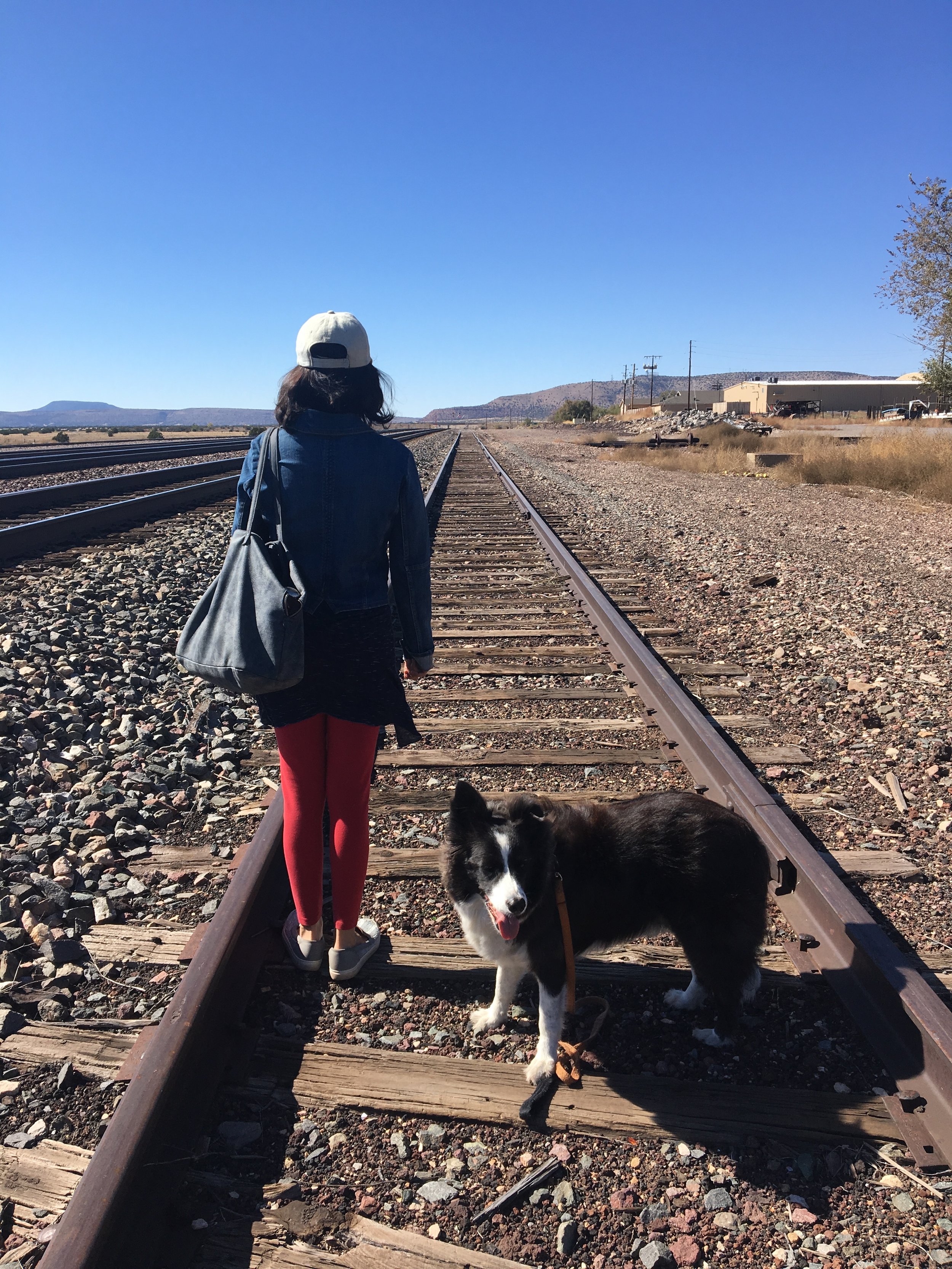

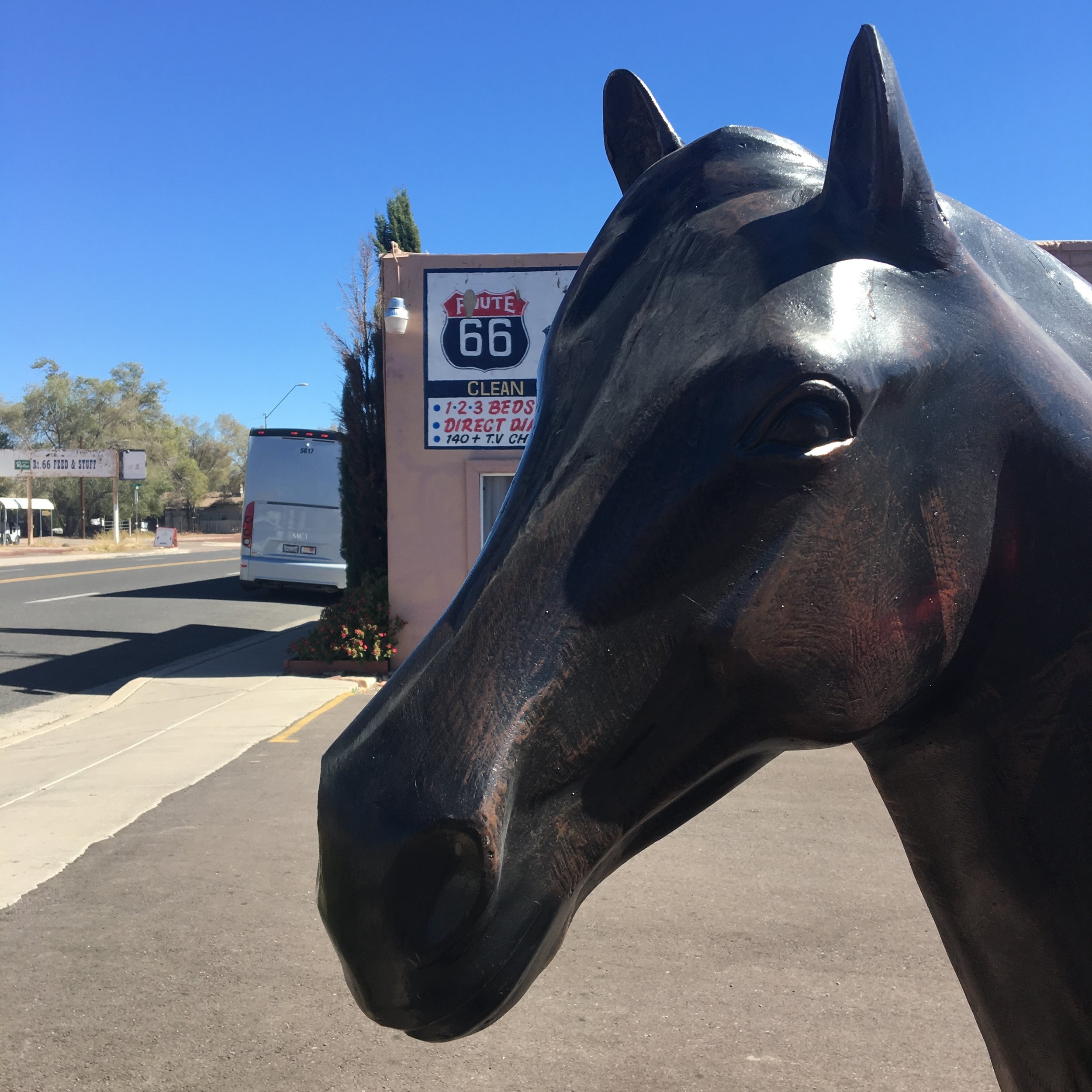

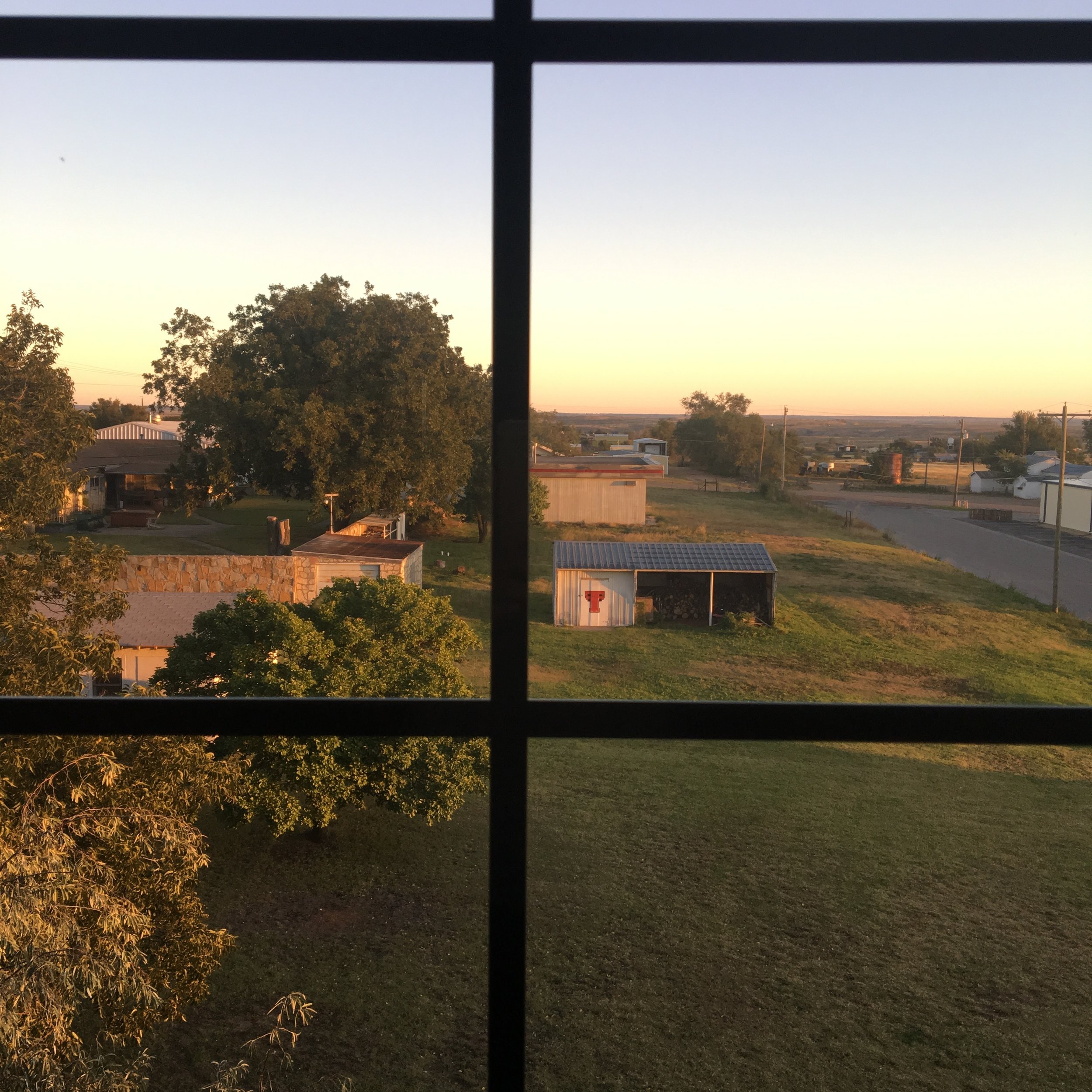

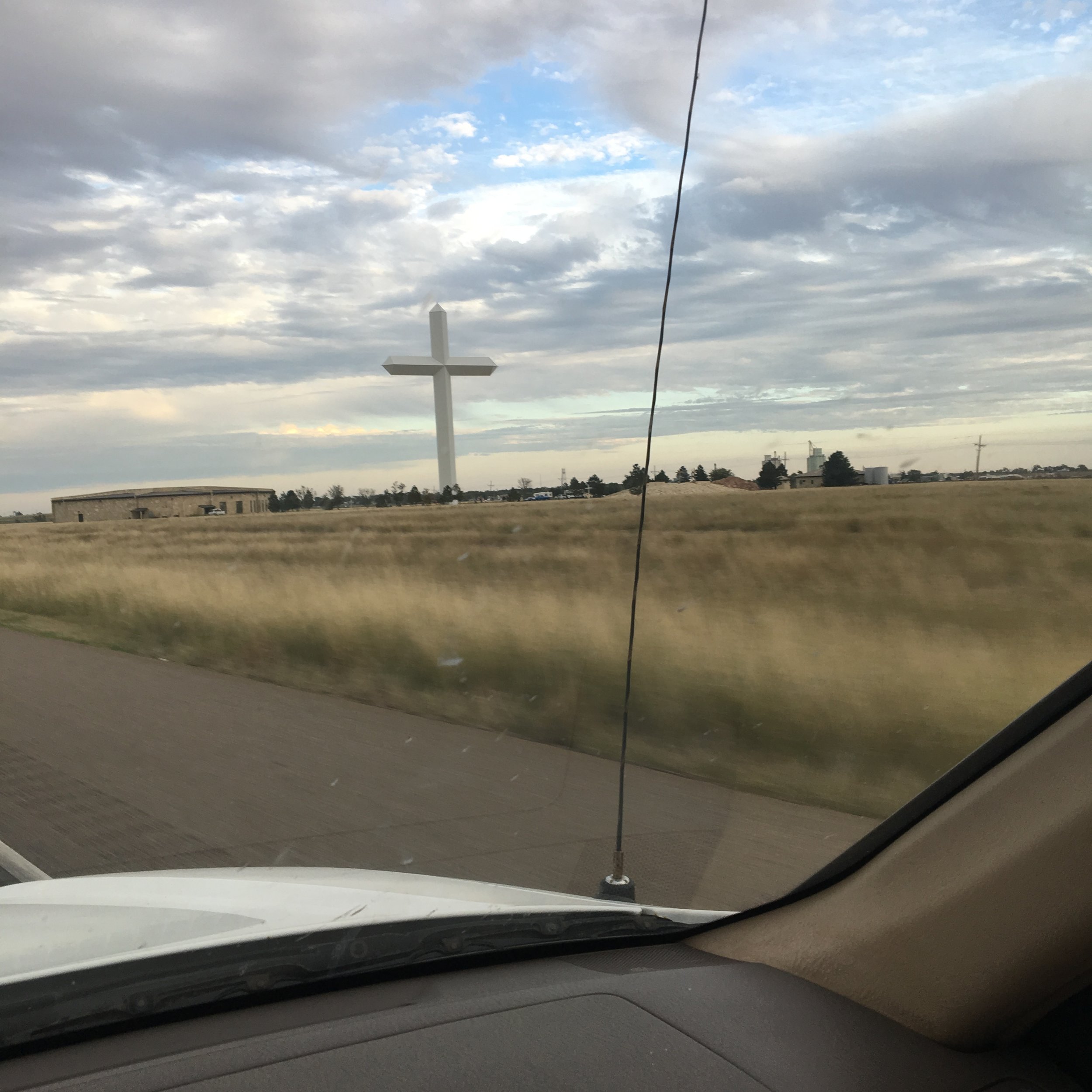
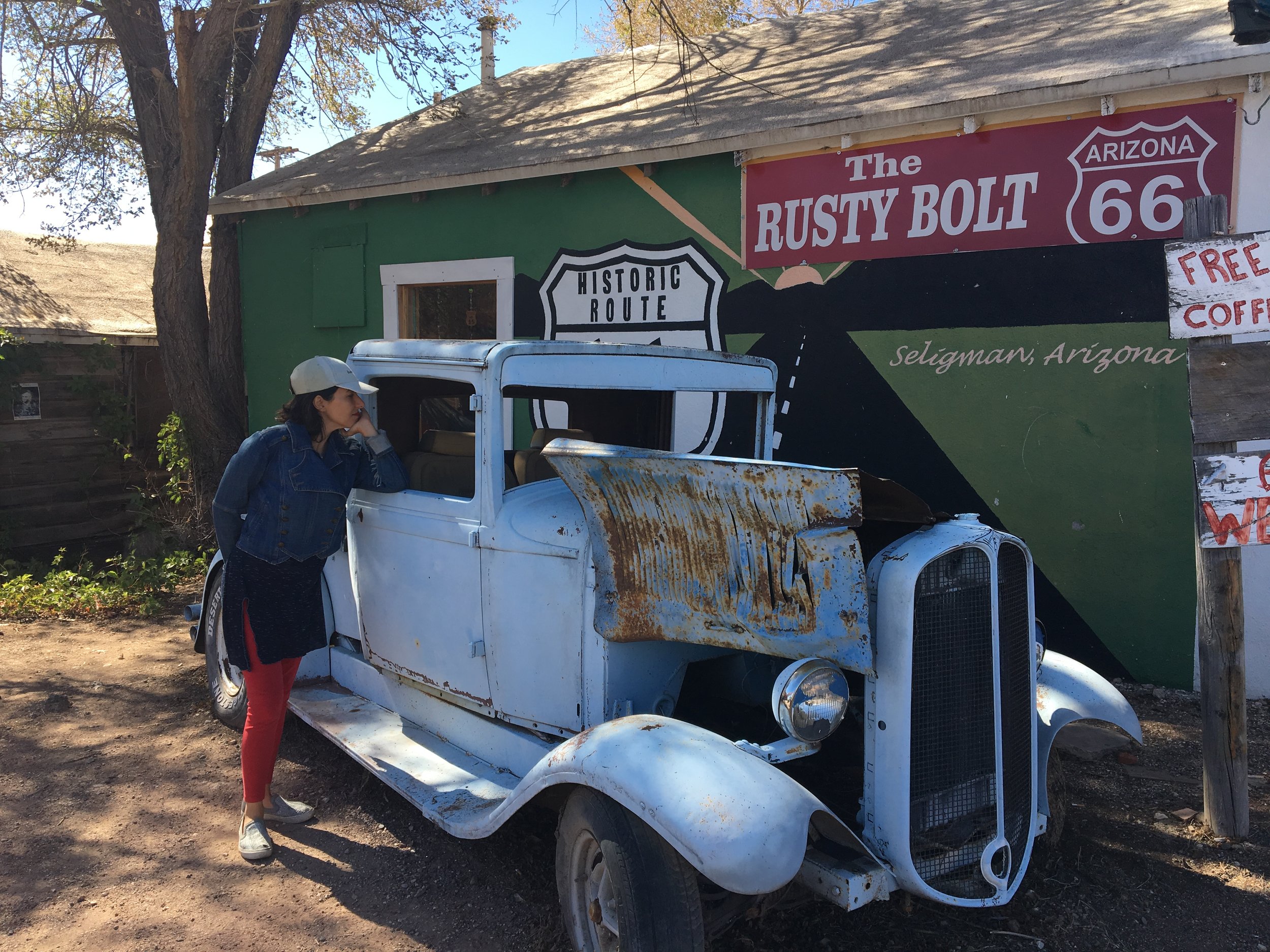
I departed LA with my dog and BFF, Maryam, on Monday, October 9th, 2017. I was so nervous and worried and my stomach was churning with fear. Not exactly auspicious vibes. Within an hour my jacket flew out of the window. A few hours into the trip, the car broke down. We ended up stranded in Seligman, Arizona for four days, bleeding money and bleeding soul juice. I was, on the one hand, jovial and making the best of things, and on the other hand, filled with terror and fear. What kind of terror and fear? That needs a whole new paragraph.
I don’t know whether you’ve ever experienced this, for me, it was a new perspective. I got the first indication of it on July 4th, which was the second day I lived in my car. I had managed to run around all day and pick up all the stuff I needed (wood, tools, mattress, plastic containers, coolers, etc.), but it was very hot and I felt harrowed the whole time. I had secured my best friend’s driveway so I could empty out my car, take out the back seats (I had watched Youtube tutorials that taught how to remove the seats) and build my platform bed. I chose 4th of July because her roommates would be at a pool party all day. Because, all summer, we lied to Maryam’s roommates and to everyone else including my mom. Lied through our teeth. I told everyone I found temporary, cheap housing nearby. We didn’t want to burden everyone with what would have been a very difficult thing for them to understand or live with. Maryam could barely understand but she helped me shoulder that crazy burden all summer long. Anyway, after I was done with all that work in the suffocating 100-degree heat, I met Maryam so she could help me get a gym membership. I desperately needed a shower by then. As we walked to the gym from her house, I told her that I felt scared, truly frightened, because I felt I had purposely taken a stable life and thrown it into absolute chaos. This action of throwing my life into chaos was one that I didn’t seem able to control. It had this insidious power of coming on as my own idea, an idea that I had concocted, one I supported and found perfectly rational and reasonable.
While we were stuck in Seligman, I started to get that scary feeling again, like I was throwing my life into chaos, that I had no control over my own actions. I began to see that something autonomous was controlling me and my desires and forcing me into these crazy situations. I felt it, in the way you might feel a hand when it’s closing around your throat. There was also this feeling of inevitability because I knew from the beginning that I had to make the journey alone, but I had acquiesced to my mother’s request that I not go alone. In the end, that’s exactly what happened. My inevitable solo cross country (literally across the face of the country, Los Angeles to Virginia) road trip which came with all these feelings of fear and this sense of having been abducted by a force beyond my control—it demanded to be and so it was. I dropped Maryam off at a very cute cafe in Flagstaff around 4 pm on Friday, October 13th, and off I went, back onto Route 66 heading east. The feeling of dread accompanied me for a while longer but it was getting less intense. I needed to be alone with my demons and finally, I was.
I kept my spirits up with dreams of how successful I would be in my new venture, how much glory there would be in finally getting my heroic life in order, and how nice it would be to have a stable family life again, with my brother nearby and my mother coming to stay with me. I drove twelve hour days for four days, sleeping in creepy motels along the way in Gallup, New Mexico, Shamrock, Texas, and just outside Memphis, Tennessee, finally making it to my five-acre oasis late at night on October 16th.
From the minute I got off the freeway I knew something was wrong. There were no street lights anywhere, and the road directions my phone was giving me were taking me up and up deep into the woods on dark winding roads with no streetlights. I suddenly realized the food store was nowhere around, so I turned back and found the store and got some food and water. I had absolute vertigo by then because I had been driving for fourteen hours, my body exhausted and vibrating. When I got back to the car, my phone said No Service. I drove up to a poverty-stricken looking store on the main road and called the landlord’s daughter and she gave me written directions. I got completely lost on those roads because I missed that first turn in the dark and it took me forever to find the place, especially because I just couldn’t believe my eyes. The road I was to be living on, Dobbins Farm Road, the road I had fantasized about, was a super narrow unpaved road leading down and down and down into what looked like a scary forest in pitch black darkness. With the car lights shining on the entrance to the road it actually looked like a scary scene from a Snow White illustration where she’s lost in the woods and the trees come alive and menace her. I was terrified because my gas was running low and my phone was out, so if I got lost I had no way of letting anyone know. Plus, it was like forty degrees outside. I finally decided to believe that the house was actually down that road and I started to see mailboxes with numbers that were getting bigger until I finally found 1003. I managed to get inside and was met with a massive mildewy mold smell and a house that was way smaller than the pictures had shown. I was overwhelmed with a feeling of having just made a huge mistake. Over the next eleven days, I alternated between trying to make the best of it and feeling like I hated the place. I was barely sleeping, the place was filthy and isolated, and the landlord ended up being a slumlord asshole from hell who, among other things, hadn’t even put smoke detectors in a house with a wood stove. I felt unsafe from the moment I set foot in that house.
What I discovered one day when I sat down to read, was that all I really wanted to do was read and study. And I realized that this farm idea and all the heroic questing in my heart, the throwing my life into chaos for the sake of some heroic achievement with its fantasies of recognition and “success,” these were not my own but given to me, bequeathed to me, by a demonic and spiritually degraded father who hates himself, and hates me because I remind him of himself. I was basically just following a code written into my soul by his insanity. I felt some instant relief when this realization hit me. I reorganized my spiritual goals and got the hell out of that house.
Fortunately, I found a lovely little house in Roanoke owned by the most adorable couple and I’m finally safe and cozy.
Now that I’m writing this story from the safety and comfort of my awesome study, I’m looking back on this incredible journey. I think I lived through a literal version of questioning my inherited code. I took a long, hard look at what my parent’s lives had been and I determined to live in a different way. This meant slogging through a few months of rage because first we must become enraged at the stupidity which caused our suffering, and we must find someone to blame for it. But if we are wise, sooner or later we reach a new level where we can accept responsibility for our choices and also start to see how the dark stuff gave us immensely valuable lessons, and these become the more stable ground of our new being. I would still be under the control of that diabolic paternal heroism instead of happily engaged in my private little world of scholarship if it were not for this dangerous and difficult journey.
From the ancestral and cultural chaos to the peace of just being me, getting to this place where I can say to myself, “Yes, actually, you are just fine, exactly as you are, with all the usual amounts of garbage and goodness that all people have” is what this whole thing has been about. And this realization has opened the door for the divestiture of deeper things, the ancient things I couldn’t let go of before because I was still in the thrall of old narratives. Old ghouls and demons are connected to these places of the deep. These will go and leave behind vast open spaces where new things can come and live, nicer things, living things. Compared to this new letting go, living in my car looks like child’s play, like play-acting about divestiture and non-attachment, while this new shake-up feels like the real thing. It’s deep and subterranean and heavy, like Saturn.
Once, many years ago, I read about letting go. I recall thinking, “How? How does one let go?” It’s an ongoing process and one day I found it in the breath. But I underestimated the power of self-delusion. In every phase of my life, I have thought of myself as an open-minded person who is committed to self-awareness and personal growth. But the more I grow up, the more evidence I find of all the times I was just lying to myself, not seeing the complexes that were ruling my choices and behavior.
I want to wish for and work towards peace and stability, but I have to be careful about all the projections about life. I’m going to have to just take it one day at a time for now and watch myself like a hawk. The nonexistence of anything solid or permanent is finally sinking in and it’s very disorienting. But I’m glad that the ancient old subterranean gateway has opened.
Let my captive ghouls go to a new home, just as I have done at last.
In Search of The Feminine: Inanna’s Descent and the Rebirth of a Woman Artist

Part One: What Is The Feminine? Why Seek It? How?
When it comes to the topic of “the feminine,” most of us will readily accept that it is a highly convoluted idea with many interpretative possibilities and not a little controversy. But when it comes to the notion of the mythical goddess, to whom this idea of the feminine is attached, it becomes more difficult to reach a consensus. My personal view is that the very notion of “the goddess,” any goddess at all, is a labyrinthine one whose significance seems to be primarily academic. The truth is that as regular women in the world, we cannot discover the goddess anywhere. We can only find her in trite and tired superficial attempts, tying shawls around our waists and lighting candles. We usually reach for tribal symbolism as though that is all there is of the goddess, her tribal aspect. We barely even try to move beyond the popular, even grossly sexualized, symbols of her toward the terrifying, the inscrutable, and the obscure where she resides. Perhaps one reason for this difficulty in accessing clarity around the feminine, or the goddess, is that these ideas are archetypal in nature while their representations in the world are concrete and formulaic. As contents of the collective unconscious, archetypes are amorphous, primordial, and unknowable, yet, ultimately, very real. They are responsible for the unstoppable creative reality of the psyche. In fact, they create consciousness as we know it. But they become something entirely different when brought into common consciousness. C.G. Jung says that: “. . . primitive tribal lore . . . myth, and fairytale . . . are no longer contents of the unconscious, but have already been changed into conscious formulae taught according to tradition” (Jung, 1936/1969, p. 5 [CW 9. pt. 1, para. 5]). He further states that “the term archetype refers . . . only to those psychic contents which have not yet been submitted to conscious elaboration and are therefore an immediate datum of psychic experience” (Jung, 1936/1969, p. 5 [CW 9. pt. 1, para. 5]). In other words, Jung’s assertion is that archetypes are no longer archetypes once they have been translated into definitions and molded into recognizable traditions. They are, by their very nature, amorphous, meaning they have no knowable forms. They are psychic emanations which point to misty feelings and can only be approached through images and even then, as James Hillman has complained, the mind’s capacity for defining and categorizing often kills the archetypal image, capturing it with words, the way a hunter captures and kills a wild deer, robbing it of its primal vitality. It is no wonder then, that we cannot locate the goddess anywhere since the goddess has undergone so many intellectual transmutations, iterations, and redefinitions that she is no longer recognizable. We cannot find her anywhere, not even within ourselves, because we have lost our connection to the archetypal unconscious, the vital source of the creative soul, right along with every other useful part of ourselves. Our mystically archetypal myths, the stories which nurtured, nourished, and guided our souls have long ago been replaced with dictates, orders, and unnatural rules. We are left with imitations and bumper sticker cliches which leave us feeling bereft, sad, and incomplete.
In her book Descent to the Goddess (1981), Sylvia Brinton Perera calls the return to the goddess a quest “for renewal in a feminine source-ground and spirit” (p. 7). Accordingly, my work seeks to approach the mystery of the goddess and the archetypal nature of the feminine utilizing a reimagined, preverbal, mythical attitude that conjures her within the depths of the collective unconscious to which my consciousness (feminine or otherwise) also belongs. “Myths are first and foremost psychic phenomena that reveal the nature of the soul” (Jung, 1936/1969, p. 6 [CW 9. pt. 1, para. 5]), therefore a properly oriented mythical attitude is primarily interested in the psychological dimensions of the goddess archetype as an expression of soul. The goddess is lost to me, therefore my project is hunting for a practical pathway back to this deeper feminine wisdom that, as a woman, I am told I naturally embody yet cannot connect with in any meaningful way.
Seeking a viable connection to the archetypal goddess requires a willingness to contact and commune directly with the unconscious itself since it is the source of her existence. Perera calls this space the “affect-laden, magic dimension and archaic depths that are embodied, ecstatic, and transformative . . . preverbal, often pre-image, capable of taking us over and shaking us to the core” (p. 14). For Perera, a descent to the inner, unconscious realms of the psyche is the prerequisite for recovery of a whole feminine self. Fortunately, Jung devised an ingenious method, based on ancient vision quest practices, for talking directly with the unconscious. He called this method Active Imagination. Active Imagination is essentially a way for the conscious ego to connect and dialogue with the archetypal contents of the unconscious through their only method of communication—images. By observing and studying the images the collective unconscious presents us with, predominantly through myths and dreams, we can do what Jung did in his Liber Novus (2004), which is to study “the myth-creating function of the mind” (p. 19) thereby gaining access to a vast store of information and knowledge hitherto buried and unreachable. Interacting with this “myth-creating” function, speaking with it, expressing its message through art, all these provide us with a method for understanding the self, understanding the world in which we live, for making meaning out of our experiences, and for expanding consciousness, including the dual consciousness of masculinity and femininity, god and goddess. As creative products of the unconscious, myths are a symbolic discourse on the interior actions and dramas of the human psyche and are intimately connected with dreams and imaginal figures. They can manage a psychic breakthrough into new meaning, unearthing unconscious contents and bringing them into consciousness by acting as a projection screen for the psyche. Indeed, this myth-creating function of the psyche is, according to Jung, the very source of consciousness and the ability to speak to the figures inhabiting this mythical landscape can facilitate life-changing transformations.
A keen awareness of being entirely disconnected from the feminine opens for me an urgent doorway for engaging in this type of endeavor. I tend to feel a sense of shame and embarrassment when the goddess is mentioned. My simmering rage and general unhappiness, strange bedfellows whose torment I’ve endured for years, born of unpleasant paternal and childhood experiences, impel me to undertake a journey similar to that of Inanna, Queen of Heaven and Earth, the central figure in the ancient Sumerian myth, The Descent of Inanna. This descent, as it is described in the myth, is the pathway to my fullest embodiment of a self rescued from the dysfunctional clutches of a one-sided, logos consciousness, for I am what Perera calls a “good little daughter of the patriarchy,” living my life with a consciousness given to me by the Fathers, my mythical lens operating with an “animus-ego.” I have a growing awareness of having been hoodwinked, captured, and degraded by the narrative of the male-dominated worlds in which I was both raised and continue to live. The myth of Inanna teaches us that just as the soul must descend into the body, the differentiated ego must descend into the unconscious where a “ . . . sacrifice to and for the repressed, undifferentiated ground of being . . .” must take place “. . . with the hope of gaining rebirth with a deeper, resonant awareness” (Perera, 2008, p. 14). We go into the dark abyss of the unconscious and there, sacrifice our modern, supreme, acquisitive egos along with the ever varied achieving-woman-soccer-mom identities they come with in order to find our softer, and perhaps even our more terrifyingly honest, irrational, and autonomous selves.
Women today live in a world which is rapidly self-destructing even as it devours our bodies and our children. The images we have to support us mostly involve the degradation of the feminine as seen in the preponderance of pornography which turns female sexuality into the plaything of men, and in a gargantuan media machine that teaches us to value a superficial youth at any cost. All feminine qualities are judged in relation to how valuable they are to masculinity. But even more than that, we partake in our own degradation by upholding these values in our everyday lives since they reside in the very depths of our mythical consciousness which has been hijacked and overtaken by the mono-myth of a heroic, patriarchal lens. As Perera (1981) makes painfully clear, our conundrum as women is a tragic one:
We have grown up as docile, often intellectual, daughters of the patriarchy, with what I call “animus-egos.” We strive to uphold the virtues and aesthetic ideals which the patriarchal superego has presented to us. But we are filled with self-loathing and a deep sense of ugliness and failure when we can neither meet nor mitigate the superego’s standards of perfection. (p. 11)
Growing up in a logos-centered world, we are taught early on to observe the requirements of decorum and propriety, identified for us by our fathers and grandfathers. We are put into ridiculously frilly clothes, segregated from the boys of our age group, and taught to observe silence. When sexual awareness begins to flower, we are taught to guard our “modesty” and not to dishonor our families with our filthy desires, because female virginity is a prize sought by many hunters, it is worth something to the male ego, it belongs to him! Our natural femininity is defined as sinful and dirty and we are shamed into obeying our fathers, uncles, grandfathers. Our mothers are reduced to manufacturing centers for food and children, their locale firmly established in the kitchens and the backrooms of the home. If we are raised in families that value education, we are taught to work hard and outperform the men, but not by too much, and not too frequently. Even when we are high achievers, we are still condescended to by our professors, our lovers, and our husbands. At work, we must either adopt an entirely masculine, often ruthless set of guiding principles or be ostracized if and when we exhibit “feminine” qualities such as crying or compassion. We are aggressively discouraged from, and punished for, exhibiting any of the darker sides of a feminine nature, even by other women, even by our own mothers. Here, again, Perera is instructive, showing how we must be: “. . . the good, nurturant mother and wife; the sweet, docile, agreeable daughter; the gently supportive or bright, achieving partner” (p.12) if we wish to be accepted and if we wish to succeed. She goes on to say that “. . . this collective model (and the behavior it leads to) is inadequate for life; we mutilate, depotentiate, silence, and enrage ourselves trying to compress our souls into it . . . .” (p.12).
In my view, there is no question that Perera is correct in her assessment of what happens to a woman’s psyche when she is forced to adhere to these unnatural-to-her standards. In my forty something years on earth, having had access to multiple cultural vantage points, I can only see a world in which women and girls are raped, abused, imprisoned, enslaved, manipulated, shamed, taught they cannot live on their own without men, told they must marry if they wish to “be happy,” taught that their sexual desires are filthy, told they are whores and prostitutes if they do what they wish with their bodies or if they have multiple sexual partners, forced to uphold abhorrent values such as murder for personal gain, war, and greed, taught to deride and compete against one another, and seen their naturally occurring metaphysical qualities defined as witchy, dark, and satanic. Here we can see just how a mythical structure can dictate the outcomes of practical reality. It shows us how much it matters which myths are dominant. It seems clear that new ways of understanding, accessing, and empowering the feminine within ourselves and around the planet are not only sorely needed but should be propitiated and propagated with fanatical urgency. An empowered, feminized population would not put up with the kinds of systematic abuses women and girls face on a daily basis. Indeed, an empowered, psychically balanced population would not put up with any of the injustices that have become standard practice in our world.
Part Two: The Goddess as Pathway to My Feminine Self
Taking direct inspiration from Mary Beth Edelson’s goddess themed work Woman Rising (1974), receiving wisdom about the nature of the goddess from Christine Downing, reveling in the prehistoric sand dunes of time found in the mysterious myth of Inanna, and working with C.G. Jung’s definitive and transformative method of Active Imagination, I have woven a personal tapestry of words and images which I hope will point to her and her locus. I have striven to live inside the deepest parts of my soul these past few weeks, holding ideas of her in my heart, meditating, reaching for states of devotion, continuously begging to be allowed in, to be shown the way. I have worked with Jungian methods for knowing: the shadow, the animus, the archetype of Self, of Mother, Sister, Father. I have let my ego be shattered, watched it scream as it drowned. I have learned to question and let go of what I think I value and know. I have walked and slept and dreamt and spoken with these amorphous beings of the unconscious as best I know how. As a practicing artist, I have reminded myself again and again that the uninterrupted connection with my own source of infinite creativity is the feminine, how can I ever have lost her? How can I have betrayed her within and without me so utterly? This line of inquiry leads me to the moments of wounding against which I rage, and I discover all my male counterparts there. They give me shame, violence, hatred, jealousy, and the destruction of my unbridled feminine joy. In these moments, I also see them capture, mutilate, and kill my once unstoppable fountain of creative energy. As I look on, behind these cruel moments I see a tall and powerful figure in the wind, gently observing.
In Women Dreaming Into Art (2006), Patricia Ariadne describes how Mary Beth Edelson, with her modern artistic reinvention of ancient goddess rites and rituals, wanted to overturn the stereotypical notion that women did not have “direct gender identity with the sacred” (chapter 5, para. 2, loc. 1218). Mary Beth Edelson was interested in expanding awareness around the universality of womanhood and the multiplicity of feminine consciousness with all its various expressions in the world, including the day to day activities of being a woman, such as cooking and child-rearing. She wanted to explore, define, and to some extent create, a new consciousness that was devoid of stultifying cultural norms and the many limits of personal and spiritual experience forced upon women living under patriarchal rule. The ancient mythical goddess mutates herself, in Mary Beth Edelson’s work, into a powerful instigator for the cultural and social transformations we need and seek, exhibiting one of her many psychic potentials. Christine Downing, in her pivotal book The Goddess (1987) explains a further, perhaps even deeper, role of the goddess as a “giver of dreams and omens, of the understanding of the hidden” (p. 13). The vital truth of the goddess, her non-transcendent, earthbound and creative nature is examined and connected to the profound recognition that the goddess is both creator of food for life, and is food herself. As she changes blood into milk in her body, the transformative nature of her creative power then rightly corresponds with the realm of the mysteries of life, so “the food associated with the feminine is food as mystery, food as transformed substance” (p. 11). In other words, the goddess and her feminine attributes are the very sources of necessary psychospiritual transmigrations which all consciousness requires regardless of gender.
The goddess has been torn asunder and all her psychic variety differentiated, qualified, and the unacceptable parts of her banished to the underworld. In The Descent of Inanna, a pathway is provided for this differentiated goddess to regain wholeness. As women, and feminist men, we must follow this pathway, for we too are torn apart, our “hated” parts banished into the depths of the unconscious where they fester and complain and rage. Inanna begins as a young girl who rejoices in her beauty and feminine sexual vitality. She embarks on a journey to test her powers, marries the correct man, but eventually realizes that she is incomplete, that half of her is banished and that she has yet to experience the darkest aspects of life and of womanhood. She knows she must recover the lost parts of herself, she hears the edict of the soul: “Expand consciousness!” deep in her heart. She descends to the dark unknowable realm of the unconscious, leaving behind all her achievements and belongings, reaching the underworld where her sister, Ereshkigal, the symbol of the repressed aspects of feminine nature, resides. There, her differentiated, imbalanced state is judged, her ego is shattered and brought low, and in death, she is worked upon by the regenerative and life-giving forces which are beyond her power and which must be procured for her by others and by magic. Inanna undergoes this excruciating transformation willingly and this appears to be yet another requirement for the blessings of wholeness, one must suffer willingly. In time, she is reborn and able to return to conscious life having been forever altered and now in possession of her full feminine nature which is light and dark, soft and hard, sun and moon. She is no longer differentiated, no longer defined in relation to one thing or the other, and certainly not in relation to the masculine. In my view, this is how the feminine is finally and ultimately defined. I have searched for an answer to the question: “What is the feminine?” and find the answer in its total absence of a differentiated consciousness, for the feminine includes the masculine. Christine Downing (1981) explains it this way: “The being of the goddess is related to her having a feminine body but it is not delineated by that. Indeed, the earliest traditions seem to have imagined her as parthogenetic and thus androgynous. She is feminine—and masculine” (p.13). The preverbal psyche is not gendered. Light is born from the depths of the darkness. So, if anything, the masculine is born out of the the feminine.
In the creative work presented with this paper, I have tried to show how I lived with the mysteries of the feminine and how, through creative practice, sought an explanation for the rage I have felt toward this world for the last few years. I am amazed and dismayed to find the extent to which I have willingly participated in my own psychic demise, and, as Perera states, the extent to which I have willingly “fled from the full-scale awe of the goddess” in order to “earn” my “striving, progressive, heroic” and “patriarchal stance” (p. 7) in the world. Finding myself suddenly shorn of this “striving” identity opened for me the psychic possibility for a genuine quest. In an online journal elucidating the details of the work called Woman Rising (1974) by Mary Beth Edelson, an explanation is offered for why women should approach the goddess through art and ritual:
In the image of the Mother Goddess—ancient and powerful—women of olden times found the reflection of their own deepest feminine nature through the faithful performance of the ritual prescribed in her service. Those faraway women gained a relation to their Eros. (p. 6)
By working with primal materials and the windy solicitudes of an early morning Sumerian desert, I sought to reach this “relation to Eros” by constructing intuitive images out of twigs and other natural objects which gave me a sense of a preverbal understanding of nature’s attitudes toward the day, the moment, or a lifetime. These temporary symbolic expressions created quickly and left behind, I photographed. I emphasized “doing without doing,” simply placing my mind on a feeling of womanhood, or an image of the goddess, which admittedly, I can neither define nor see clearly, but with an intention of being guided into allowing the creative urge to simply express itself. This natural undefined work without psychic borders and without definitions seems to me a very feminine action in its unconditional nurturing of the creative moment.
On August 7th, the day of the full moon and partial solar eclipse, I engaged in a quiet, personal ritual with the aim of approaching, sensing, and perhaps embodying the goddess by actively worshipping her. I stood in a grove of citrus trees and set up my tripod and camera. I spoke some words in my heart, I burnt some sacred leaves, I poured water, and I lit a flame. I shot some photographs that I hope express my awe toward the total mystery I encounter when I think of her. I have combined the twig symbols and the infinitely-mysterious goddess photos into a mosaic of interrelated images which, for me, symbolize the varied and unknowable aspects of the feminine goddess archetype and her three iterations, the young girl, mother, and grandmother. I am including the active imagination dialogues I held with Inanna and Ereshkigal. I cannot say that I used images from these sessions directly, only that the two goddesses guided my every artistic move because I allowed the unconscious to dictate the outcome of the work.
It is difficult to embark on a relatively short project on a topic as deep as the archetypal goddess and then to say definitively that something concrete has been discovered. I have not been fortunate enough to spend years studying this vast subject and can therefore only express myself subjectively. Nevertheless, two primary personal discoveries from this work come to mind as holding some significance: 1) The initial journey to the goddess is a solitary one that each of us must make on our own, and 2) The journey to the goddess is impossible without a reverent, almost religious, attitude. For me, as a woman living with the uncomfortable realization that I have been actively participating in a mythical narrative which imprisons me within a false sense of self and robs me of my feminine autonomy, this work has provided a practical pathway toward the deeper, quieter, and more mysterious sides of my feminine nature. For one thing, I find that I am striving to speak less, and I am growing very suspicious of my heroic desires. It is as though I am moving toward a deep and dark lake alone at twilight. I have left many things and people behind but I am not frightened. There is no great hurry, either, instead, a quiet confidence exudes itself. Like the slow but sure regenerative work of a corpse transforming into compost, the germs of new life are slowly eating away at my old mythical foundations, blowing in like a sand storm disrupting the long-standing statues of the Gods, pouring into subterranean chambers like endless flowing rivers, drowning old, outdated figures and disavowing unforgiving paternal voices. There is no way to outline definitive outcomes, but the work of creative psychic transformation has begun. I can see her and talk to her now when before I couldn’t even name her. The way I know that this infinitely creative conversation has truly begun again is the fact that I am once again painting and drawing with abandon, without fear, and without wanting or needing anything in return for my creative work. I am prioritizing being an artist again. My search for the feminine, for the goddess, has brought me closer to a place I once knew very well. I’m almost there, but not quite yet, which itself perfectly encapsulates the paradoxical nature of the goddess and the infinitely varied journeys to the self.
References
Ariadne, P. (2006). Women dreaming into art: Seven artists who create from dreams. Lakeville: MN. Galde Press, Inc. [Kindle edition. Retrieved from amazon.com].
Downing, C. (1981). The goddess: Mythological images of the feminine. Lincoln, NE: Authors Choice Press.
Edelson, M.B. (1974). Woman rising. Henri Gallery Exhibition Pamphlet. Retrieved from: www.marybethedelson.com/essay_WomanRising-Henri.html
Jung, C. G. (2014). Archetypes and the collective unconscious. In R.F.C. Hull (Trans.), The Collected Works of C.G. Jung: Complete Digital Edition (Vol.9, Pt. 1, pp. 5-6). Princeton: NJ. Princeton University Press.
Perera, S. B. (1981). Descent to the goddess. Toronto, ON: Inner city books.
Active Imagination With The Goddess Inanna
Part One
I’m walking in the desert. I have a white shawl around my head. I’m alone. The desert wind blows, the sun is high.
From the horizon, She rises up. She’s so huge she takes up the entire horizon line, vast as it is across the desert. A circle surrounds her hair, a headdress with sun rays. It is the sun itself.
Her hair blows and blows around her. Tears come to my eyes as we stand there, She floating, me standing, in awe and a puddle of tears. She is smiling and wondrous.
I bow down, I place my forehead on the hot sand. The sun is covered now, we are in the shade. She is wearing dark gray robes, I am wearing white cotton garments, like a Pilgrim's.
She just looks at me with gentle benevolence. She waits for me to tell her why I have crossed the desert to see her.
I: I’ve never known you. You have been kept away from me. I’m only discovering you now and I feel mournful and sad that all my life they have kept me from you.
She: Your body is very hot from all the years it has taken you to cross this desert and find me. I always knew you would find your way back to me. Soon I will take you to a cool place with life-giving waters where you can rest and restore your precious self. I am pleased by your devotion. You never forced yourself on me even though you have forced yourself on others and been forced upon in many ways.
I: Can you show me how to stay close to you now? I never want to leave you again. You and your sisters are my mothers and I have been very lonely out in the desert without you for a very, very long time. How can I know you and stay close to you now?
She: The goddesses are never far from you. You cannot lose us. You can only forget us. So where in your memories can you find us? For we are always there, just beneath the surface of man-made time and its speedy ideals. In my heart, I can see that as a child of the stars, your beautiful art-making abilities, and gifts—they come so naturally to you. What is nature? Nature is another word for the goddess, for me and my sisters. So the thing that comes naturally to you is a gift from the goddesses. How you stay close to me and my sisters is by doing and doing and doing that which comes naturally to you. You have recently made a monumental choice about the direction of your life from this time onward. I want to affirm for you that this is the right choice and it will bear many fruits for you and the millions you will come into contact with in the future through your art. Move forward into this new decision with ease and patience but with the easy confidence of a righteous goddess. I give this confidence to you. You have spent eons doubting yourself. It was very noble of you to put yourself through such difficult tests, but you needn't do that anymore. I have come to you today at the edge of time in Eternity’s desert to praise and love you and to tell you that even though you think you have been held back from us, we have always seen and known you and your precious and compassionate heart. We have seen the way you care for the smallest insect, the way you are always the only one to notice when a lowly beetle needs a hand, you save bees from drowning—all your life you have been working on behalf of all the goddesses tending and caring for the creatures of this world, for the trees and their leaves and flowers and even for the people, even though you have had your share of conflicts with them. But of course, that is perfect and natural and just as it should be. There is no growth without conflict. When I came back from the underworld I was a changed being. Now was I a woman and a true goddess. Once we see and learn the ways of the underworld we can never be entirely carefree again. Do not beat yourself up for your serious nature. Soon you will meet Artemis herself, you are her natural-born daughter. There is a place for a serious nature like yours. Your heart is on fire with passion and love. In the realm of the gods and goddesses that is the most priceless possession and you have it, you have always had it. Do not let Papa freak you out anymore. He is old and weak now, anyway. All the things he once believed in with such ferocity have melted away into the clouds of defiled memory banks. You are a fully grown woman now. You needn't fear yourself or others any longer. You have made it here, to my house! That is something not everyone can accomplish. I am very pleased with the new art you are making in my honor and your new decision together with your work will bring you and others closer and closer to me and my sisters. Go now, you must speak to Ereshkigal, she knows you are coming. You are blessed on this day by the Queen of Heaven. NEVER FEAR ANYTHING AGAIN, NOT EVEN HER. [An arrow points downward, indicating the "her" of whom She speaks.] I embrace you beautiful woman of the earth.
I bow to the ground with my hands on my heart. I am filled with awe and reverence. My heart is thumping and the wind is howling now.
Part Two
It’s evening. The stars have just come out. The desert is peaceful. She is walking slowly, with her back to me. She is waiting for me to catch up. Although I’ve been quiet, she knows I’ve come specifically to see her again.
Her long black hair sways behind her. She smiles at me, and her smile says: “I remember you.”
We walk for a while. We both silently enjoy the beauty around us. The desert is so clean and it sparkles and glints here and there, as though the sand is reflecting the starry sky above.
She turns and looks at me again. Stars fill the space around her beautiful face and her hair blows and billows in graceful waves.
She: But not everything is always graceful, you know that, right?
I: Yes, even though the lack of grace frightens me more than hatred and vengeance and murder. Lack of grace is worse than death.
She: There’s nothing in the world as lovely and precious as grace. But those other things have their beauty too. When you are Queen of Heaven and Earth, you love and protect all things, even murder and hate.
She watches me. I feel quiet and peaceful but the questions keep coming.
I: What can I say about you to the world? How can more people see you and feel you and revere you? How can we help each other so maybe we can learn to be kinder and gentler to each other, to the creatures, to ourselves?
She: Perhaps some things cannot be said with words. This is why we have images. Action of your Self in the world, plus the action of your images shared with the world, those two combined are how you can tell the world about me. Images convey meaning directly between souls without a need for the mind. This is the most efficacious way to communicate. Stars speak with their light and evoke such wonder and joy in the heart. Images do the same. With words, you can only get so far. You can use them to draw a map, but the map is not the territory. Only starlight can show us the way.
I: I wish I could stay here with you forever. The world is such a madhouse!
She: Our son of the desert moon and stars [she means the poet, Rumi] has said it best: Become a madman! Join in the madness gladly, this is the world, with all its beauty and all its horrors. Jump in and take delight in it all. You know from what I transmitted into your heart yesterday that nothing can ever truly hurt you and no one is ever really hurt. On one level, we are all inhabitants of a vast cosmic dream and even being stuck through with knives is just a dream. After the physical realm disappears, the cosmic realm arises in the soul and the journey continues. Death is only the beginning. This realm I am in is much larger than your universe! Do you truly comprehend infinity? If you do then you know that in infinity there is no pain and no sorrow. Nothing lasts forever in infinity. Nothing is real and there is nothing to fear.
People of your realm become occupied with the small details that make up a life but they sacrifice infinity and that’s when pain and suffering are born. With an umbilical cord made of stars connecting your hara to the realm of infinite magic, you go through life taking delight in both small details and in—words cannot adequately describe the vast, infinite, and multitudinous points of light in my realm. But you! You have spent the last few years untethering yourself from the smallness of things. Unwittingly, you have strengthened your astral umbilical cord and here you are! You can drop in to see me now in under two seconds. I know you have been speaking with my father, Father Enki. That is good, and he is genuinely beautiful in his balance of feminine and masculine. I say this because I know your own father has wounded you deeply. He is a shallow man who became very lost early on in his life. You must forgive him. He has not your courage, his fears are too frightening for him. Sing and dance and love and play, Gelareh! You are in such a beautiful time of your life. Make me and show me in your art.
I want to fly across a starry sky.
I want to cup the moon in my hands.
I want to sleep beneath a citrus tree.
I want to jump out from behind a bush.
I want to run through a wild forest at night.
I want to meet my sister, Artemis, on the full moon so we can share a blessing.
I give you another powerful blessing today. Your strong feminine nature is shedding its skin of insecurity and fear. You are combining the strength of many goddesses within your yoni, within your heart. My sisters and I can see your spirit rising up and reawakening to your true self. Your work is important, your work has value. Do not seek approval from the people around you, there is no guarantee in the thoughts of other people. Your heart is loud and clear. You must expel your father from the deepest crevices of your heart and soul. You must go and clean up in there, pour water, light a candle, burn sweet grass, write a new prayer and sing a new song.
Do it this full moon and after that, you needn’t ever think of him again. He has his own path, he will be taken care of and shown the right way, but it is not your concern any longer.
She brushes my hair aside. She caresses my cheek gently and smiles again. I can feel my heart swelling with joy. We sit together and watch the stars and the sand glinting and listen to the wind. I sense her walking away, but I am asleep, and when I wake up again, she is gone.
Active Imagination With Inanna's Sister, Ereshkigal
I’m swimming in the depths of a blue watery abyss.
All is peaceful, but I have goose bumps. I’m not afraid, exactly, but exhilarated—I feel so excited to meet Her. As usual, just thinking of her brings tears to my eyes. My heart pounds and I can hear it in my ears. I can feel vibrations of various intensity coursing through my body. I’m hot; very hot heat is rising up from my body.
She calls to me in the darkness, in the vast infinite abyss. I reach for her with my heart—my heart floats through the water, deep red against the deep blue.
She sits on a throne floating in midair. We’re beneath the ocean yet also inside some sort of infinitely dark blue cavern. She wears black robes and a black scarf over her hair. She’s calm and at ease. I approach her but I am only my heart. She doesn't give a hoot about the other parts of my body. She knows everything that matters resides in my heart.
A dais with wide stairs appears on either side and behind and in front of her throne. My heart floats in front of her and she watches it with mild curiosity.
She: Hmmmmm. I’m somewhat surprised, but don’t get excited because nothing surprises me in earnest. It's why surprise isn’t even the right word. But by now your heart should have fallen to the surface of the dais with a loud thunk. I even saw you think about doing just that, I saw you think to yourself: “My heart is heavy, I want to rest it on the floor.” But then another part of you said: “No, that's not true. My heart is no longer heavy, I no longer have a heavy heart and must let go of my past habits,” so you refused to let your heart drop to the floor before me.
And that is what is somewhat worthy of notice. Everyone submits to the heaviness of the heart when they come before me. Something has changed in you. This is why you waited until today to come and see me (you wanted to come see me two days ago but two days ago you were still green). You were unchanged and green until last night when you made a choice, and that choice has altered the makeup of your heart.
Here in the depths of darkness, few can withstand the urge to fall to the floor with mountains of water pushing them downward. Yet such a small choice, made almost by accident like you stumbled on a pebble and said: “Oh! I choose happiness!” and just kept walking—such a tiny thing yet the entire universe has shifted, entire planets have shifted and changed and all life is altered. You of all people, you, the bravest, most courageous of daughters, you, who have withstood immense sorrows and unspeakable horrors! Of course, it is you.
But don't smile so much! Your smiling is silly, don't get all puffed up, this is just one of many many tests you must pass. Yet, I cannot deny that I am impressed.
So you may kiss my hand and I will bestow the gift of sight upon you: you will never be lost in the darkness again but will walk through it with comfort and ease. You WILL walk through darkness many more times in your life, but you will never be lost there again for the darkness is my realm and in my realm, I have blessed you and given you my sight.
Da Dum, Da Dum, Da Dum . . . my heart pounds peacefully before her. She continues to watch me for a while.
The water begins to get darker.
The edges of space stretch outward.
She and her throne begin to recede.
“I love you,” says my heart.
“I know,” says She.
The Ritual Photographs




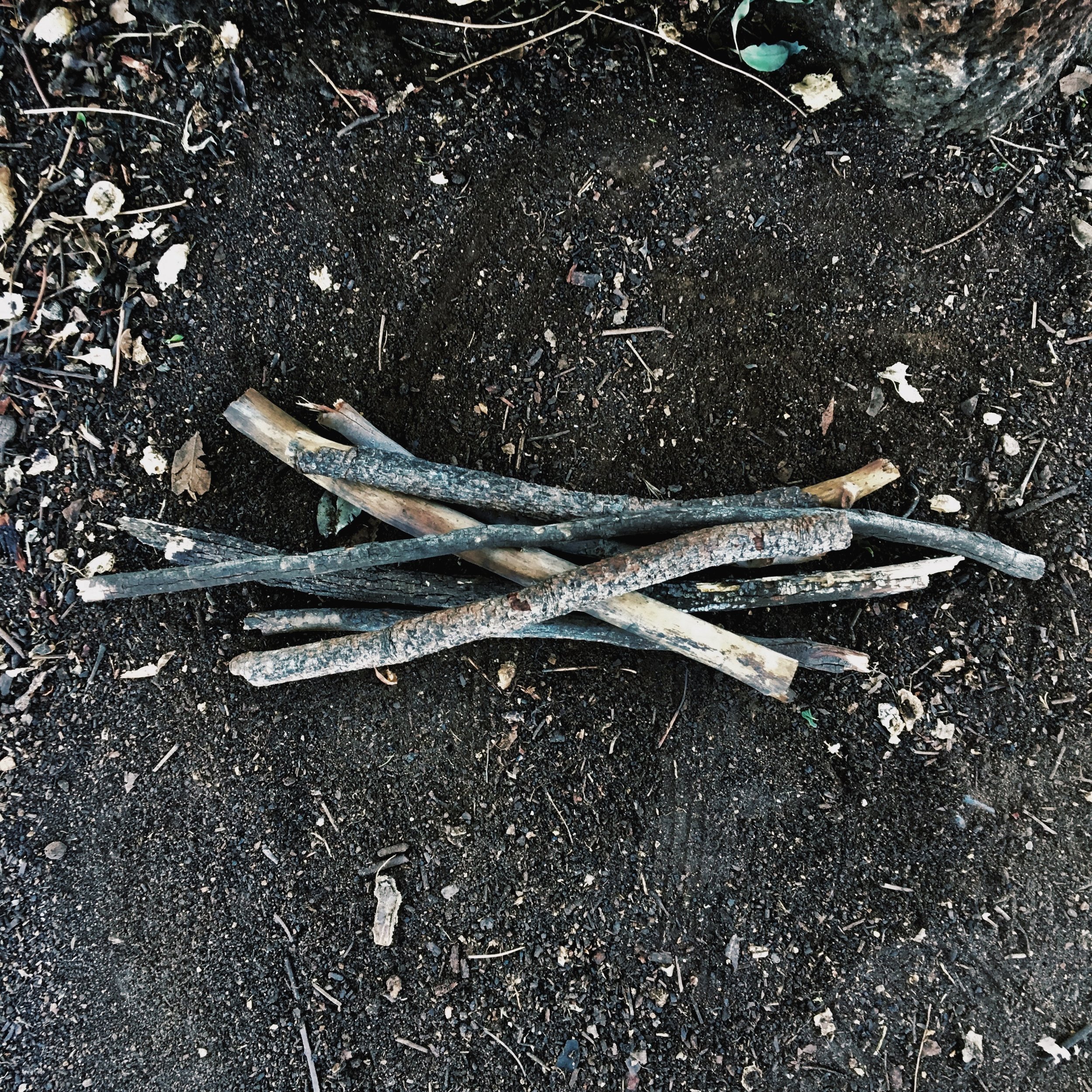





Predominantly Dreadful

There will be a lot more writing from now on. Predominantly dreadful writing, it’s true. But the writing won’t get any better if I don’t do more of it. I feel like my writing is not all horrid, just mostly. Occasionally, through cringing eyes, one can unexpectedly get a glimpse of a sparkling jewel peeking out from under ponderously illegible sentences. The little scamp will even have the audacity to wink at you if you manage not to look away in time. The point is that I have no intention of stopping writing in the way I used to stop my creative work in the past. In the past, I would sabotage myself with much passionate self-recrimination and hatred. Enough of it would erupt from the darkest depths on a regular basis to keep me in bed for days at a time. I could barely move much less exhibit enough chutzpah to write and express myself freely. I think the point has been made. Dreadful or not, there will be more writing from now on.
Why have I suddenly sprung upward with so much youthful vitality you may wonder? What has given me that twinkle in my step and pushed me forward into this greenest of landscapes? Not ambition, that much is certain. It’s anti-ambition, really. I’ve already written about my tussles with this uncommonly fanged teddy bear. I’m writing more because I’ve decided to document my ascent* from the underworld where I have been in residence for the past three years, perhaps even the past nine years, since my dog Zoë died in my arms on April 24th, 2008.
I was reading the Epic of Gilgamesh (2004) yesterday and at one point Gilgamesh is told to go into this tunnel and run as fast as he can through it even though the darkness is endless on either side and above and below. He must run through the tunnel and get out of it within twelve hours or he is lost and will never get out again. For the first seven hours “Gilgamesh ran, deep was the darkness, with no light at all before him and behind him and to either side” but “at the eighth hour Gilgamesh cried out with fear, deep was the darkness, with no light at all before him and behind him and to either side.” He continued to run through the tenth and eleventh hours,“deep was the darkness, with no light at all before him and behind him and to either side.” Finally, “at the twelfth hour, he emerged from the tunnel into the light. The sun was hurtling toward the entrance. He had barely escaped.” After he comes out of the tunnel Gilgamesh sees “before him the garden of the gods . . . with gem-trees of all colors, dazzling to see . . . . Gilgamesh looked up and marveled at it all” (p. 162-163).
What happened in the eighth hour? It is the hour in which he cries out with fear. The rest of the hours he just runs while the deep darkness absorbs him. I’ve been running in such a tunnel for a long time. I think I passed my eighth hour in early 2014, and I cried out in fear while the darkness surrounded me on all sides. I’m approaching the end of the tunnel and the garden of the gods. I want to document the way this ascent into the light looks like. I hope it appears humorous and light because I’ve been spending a lot of time with Rowan Atkinson and his absolutely genius comedic routines in the show Black Adder. He has become my unlikely guide out of the darkness and I’m so grateful.
Discovering that one has been a resident of the underworld for close to a decade is a little shocking at first. I think the time allotted for such work must be shorter, fairer. But I realized very recently that I hadn’t allowed myself to fully make the descent. My hand was stubbornly grasping a tree root on the way down and wouldn’t let go while my dead body decayed slowly in the hellish world beneath. The transformation of rotting flesh into regenerative fecundity couldn’t happen in an orderly and timely fashion since one part of my ego would not let go of the past, would not let go of the wounds. Maybe that’s because I’ve had more than my fair share of wounds. My capacity for withstanding pain is much higher than the average person so it makes sense that it would take me much longer to realize that I’m dead and decomposing.
What sets off a sudden insight? Rollo May speaks of the cosmic encounter between the unconscious and the soul of creativity in his beautiful book The Courage to Create. I don’t have it on me so I can’t quote from it, but something to that effect occurred recently and I realized that I must let go of the tree root, I must let go of the last thing tying me to my past identity. For me, this means letting go of the disco in my heart, which is very sad for me, very hard. But I sense it very clearly, that this aching love is part of my past and for new love to grow I must let go of it. The irony is that I will likely emerge from this underworld journey much more in tune and able to sing more authentically than ever before. I don’t know yet what all this will look like on the physical plane. What I do know is that I am working aimlessly, simply moving from one creatively energetic endeavor to the next without any sort of planning or intention-ing. In The Red Book (2009), one of Carl Jung’s inner selves says to him: “Do you still not know that the way of truth stands open only to those without intentions?” (p. 143). I find this non-planning and non-intentioning to be a vital portal into the magic of the day. I think the freedom it generates in the spirit is one of the fruits of authentic regeneration and rebirth. Look at the stressed out person running to and fro all day with a fast and busy spirit, then imagine what the absence of that stress might feel and look like and you will be getting close to seeing what I’m talking about. It’s very subtle, this peace can alter in a microsecond under normal circumstances. But when the magical fruits of the underworld journey are truly ripened nothing can dislodge that inner peace. In this psycho-spiritual state, even the wildest and most heartbreaking of experiences can be taken in with ease and openness. I’m not saying I’m all the way there yet, but I’m much closer to achieving and maintaining these long desired levels of equanimity and I got here by traveling through the tunnel of darkness. It’s interesting how Gilgamesh cries out in fear in the eighth hour but continues to run in the ninth, tenth and eleventh hours with no further outbursts.
At some point along the way we stop struggling and learn to enjoy the darkness. We go willingly into that dark night, rage-less. As we know, most people fear death and anything that is associated with death. But I have recently been told about the other side of death, the transformative side. When viewed from this side, death is no longer scary nor morose. It is silent and steady, focused and free. When you have died, you no longer have anything to prove and can just do your work. You also stop pretending and you stop caring what others think. It’s a very mature state of consciousness, actually. But that’s all I have to say about that for now.
Lament of the Heart-Sick: Everyone Is Selling Something (And I'm Not Buying)

In my dream last night I saw a vast cityscape stretching outward across a massive hillside. This city was endless. I was in a foreign land with a man I seemed to know. I was complaining to him about an overwhelming sense of oppression. Being part of the human race was oppressive to me and I resented it.
Driving down Ventura Boulevard today I find myself gazing glumly at all the strip malls and countless shabby-looking businesses. Every inch of space is dedicated to the hawking of some product or other no matter how seemingly useless or stupid. It’s not that I don’t need a dry cleaner on occasion, and it’s not that I don’t understand the need for shoes and food and wall painters. It’s just that selling something is now the only thing anyone is doing. I think of people in the movie business or the music business, two glamorous and desired career locations for the lucky and talented. Yes, there is a great deal of interesting creativity involved in that work but they are still salesmen and saleswomen. They transform their creativity into a product and sell it. Writers, musicians, artists—sooner or later everyone must contend with the fact that their worth derives from product(s) they can manufacture and sell. If not a creative person, then very likely you are hustling 8-10 hours a day doing something you don’t necessarily love, rushing to and fro, just trying to “get by.” That's so sad to me.
I have been struggling with this issue of economic slavery for three years now. I used to have a very “successful” business and I thought it was the bee's knees. I, too, sold a product, trying my best to keep it as heavenly and spiritually aligned as possible, but, it was still a product. Since changing life paths, I have been trying to find a way to earn a living without rubbing elbows with the economically grotesque. But, as in my dream last night, the Land of the Salesman is endless and pervasive, so I feel oppressed by a sense of helplessness as I dig in my heels further and further, simply refusing to submit to a life of tyranny and iniquity. I’m an artist but even the idea of trying to get my work sold is distasteful to me because of the transformation of the art world into a massive whorehouse and despot-manufacturing machine. Globally powerful thieves and murderers are entwined with and confirmed by the art world and I can never forgive or forget that fact (only one among many ugly truths), much less try to join in.
As you might suspect, these attitudes have left me in a rather unsustainable living situation, pushing me into exploring rather alternative lifestyles. I have divested myself of most of my possessions. In fact, all my worldly goods now fit into one suitcase and I still feel like I have too much stuff. I have also drastically reduced my living area, which is down to about 100 square feet. I have reduced my monthly expenses to the bare minimum and practice living on $2-$10 per day. I go some days without spending any money at all just to see how long I can go without consuming something. I spend my time reading, doing schoolwork, drawing, painting, writing, and reading. I do a lot of reading these days since I’m in graduate school and have deiced to go on to get a Ph.D. I suppose instead of a house, car, career, and family I’m spending my time and money on acquiring knowledge. What sets me apart from most people who go to school is that I am not immediately thinking about how I can get some cash out of these efforts. Thinking about how to make money occupies exactly zero seconds of time in my mind-heart sky. This may seem insane to others, but, to me, the exaggerated busy-ness of brainwashed, acquisitive, egomaniacally ambitious hawkers of goods and services seems infinitely more insane. There’s no space for love and beauty in that busy-ness. There is no space for you, only for me. To continue along like this while people die of starvation, while the planet is destroyed, while billions live in piss and shit and have no water, that is insane.
I’ve written before about just stopping. I think it would give most people a heart attack to just stop. For the most part, as far as I can see, people are literally on their own personalized hamster wheels, crazily spinning around and around. But for me, this stopping and really slowing down is emitting fascinating results. For one thing, I’m learning to move slowly. I used to walk very rapidly, with a purpose, with great confidence. My walk said: “Look out, I’m a woman who knows what she’s doing and I’m on a mission!” It’s funny to me now and also a little sad. I hurt a lot of people and missed a lot of beautiful things and made a lot of mistakes on that patriarchally aligned logos warpath. Moving slowly gives the myriad mysteries ample time to unfold and delight the soul. What are we trying to achieve, exactly? We are all chasing a future happiness, something we currently don’t have. But we’ll never have it because permanent happiness does not exist. The thing that exists is the beautiful thing unfolding in the moment that is being missed as we run rapidly from task to task. And geez, don’t even get me started on LA people! I suppose big city folk continually labor under the misapprehension that they lead very important lives that must be undertaken with seriousness and rapidity. There is a powerful fear of being left behind if one is too slow. It's ironical, to say the least since there is no thing to get to anywhere. It may sound like I am trying to belittle these things, but I’m not. I am just lamenting the absence, well, not absence, beauty is always everywhere, but the rejection of beauty and tolerance in an endless cityscape of me-centered busy-ness.
Why lament so much? I don't know. Maybe because I feel what I feel and I am aware of feeling it. Feeling something is a way to deeper understanding. I was told today by an inner guide that I must rejoice in the concrete forest as much as I rejoice in the wooden one. Complaining is a form of rejoicing, no? Wow, this place is tacky! People are rushing around! Crazy! There, I rejoiced by pointing out truthful facts. In her book Descent to the Goddess (1981), Sylvia Brinton Perera explains the important relevance of complaining from the perspective of a feminine consciousness:
Complaining is one voice of the dark goddess. It is a way of expressing life, valid and deep in the feminine soul. It does not, first and foremost, seek alleviation, but simply to state the existence of things as they are felt to be to a sensitive and vulnerable being. It is one of the bases of the feeling function, not to be seen and judged from the stoic-heroic superego perspective as foolish qvetching and passive whining, but just as autonomous fact--"that's the way it is." (p. 70)
I’m searching for a way to live that does not include selling something. I’ll explain by relaying an insight I had a few days ago. Where was I? In a car going to the train station, I think. There was a big white van with a giant ant painted on the side. It was a bug-killing van belonging to a bug-killing business. Suddenly, I was hit by the absurdity and arrogance of our species. We come and take over the entire planet, then we go and stick our poison-dispensing hoses deep into the underground habitats of other species, calling them vermin and pests, obliterating them all, often in excruciatingly painful ways. Have you ever stopped to consider the extremely painful way in which a rat who eats rat poison dies? But we do this kind of extreme murder every day without even batting an eye. We do this poison hose thing to the darkened shadowy inhabitants of our unconscious as well. But those beings are harder to destroy and they take vengeance when they are treated with so much incivility.
Seeing the bug-killing van made me feel ever more convinced of the correctness of my position as an anti-salesman. I want nothing to do with any species that move in murder. I will continue to search for a way to live and exist in this admittedly unsustainable netherworld. Maybe, like Thoreau, I’ll find that prison is the only place for an honorable (wo)man in an unjust state. One can’t help but think longingly of certain European countries at this juncture in the thought process! Let it be known that much is unknown.
A Numinous Disco Odyssey: Archetypal and Creative Transformation on the Disco Dance Floor
This paper was presented at the 15th annual conference of the Jungian Society for Scholarly Studies in Washington D.C. on June 23, 2017.
Hello and thank you for joining me as we take a brief but sparkly journey through the birth of American dance music culture as it awakened and called itself Disco. My name is Gelareh Khoie and I am a student at Pacifica Graduate Institute. I am a newcomer to depth psychology and this is my first time presenting at a conference. I’m going to talk today about the living underbelly of dance music culture, specifically disco, and how it connects to depth psychology.
I will give a short history of the birth of disco and its founder, David Mancuso, then I will discuss my thoughts on the archetypal nature of the disco dance floor. Lastly, I want to briefly talk about how useful these underground disco events can be in combating despair and spiritual and emotional fatigue in a time of great social distress. I am advocating for more underground dance parties as a form of social action and resistance. We cannot win any battles from a spiritually weakened state.
Very quickly I want to explain what I mean when I say Disco. Almost everyone will see this in their mind’s eye when they hear the word Disco:
These images are certainly one part of the concept but they can also be misleading because they tell only the pop-culture side of the story. The truth is that Disco is a state of mind, not a musical genre. It’s a bit like Zen in that it’s not exactly a religion yet it is definitely a method for reaching an understanding of soulful profundities. In authentic underground disco dance parties
the wildly eclectic music becomes a literal stairway to heaven leading to a place where Crosby, Stills & Nash dance with the Bee Gees. Deep disco is about engaging in a variegated and life-affirming psychic journey through music and dancing.
Before coming to Pacifica to study depth psychology, I lived in Honolulu where I founded, owned, and operated an art gallery and disco nightclub for ten years. It was called thirtyninehotel and located in Honolulu’s historic chinatown district. It was a beautiful multi-media space dedicated to uplifting and uniting the segregated art and music communities. I organized countless dance parties during the ten years I operated thirtyninenotel. But it wasn’t until I started studying the work of C.G.Jung that I began to see the archetypal side of my love for the disco dance floor. Here are some images from my old space:






My interest in the topic of Disco was sparked in January of 2001 when I travelled to Los Angeles for an underground dance party thrown by a British DJ who eventually became my guide and mentor. This one night party lasted over eight hours and was held in a large and rectangular unused warehouse.
The DJ booth was stationed at one end of the room and an enormous and magnificent disco ball scattered millions of ethereal and starlike spots all over the walls. Hundreds of people were engaged in solitary dancing reveries,

yet, all together, they also resembled one great undulating organism. My new DJ friend and future mentor wove a tapestry of music and sound that felt viscerally like being on a journey with many twists and turns, not all of them pleasing. The place had such an air of mystery, as though one had just descended into a alternate realm of consciousness.
The very next night I was taken to another underground dance party and I was struck by how similar the set up was.

Again a large rectangular space, again a DJ booth on one end, and a large disco ball hanging from the center of the room. Hundreds of people dancing in personal reveries, a strong 4-4 beat, amazing sound quality--all these features combining to produce a trancelike effect on the dancers. I was very curious. “What on earth is going on here?” I wondered. What I saw looked very ritualistic, tribal, and religious. It seemed I had stumbled upon a long established tradition with a specific purpose and I became obsessed with finding out the meaning behind what I intuitively sensed were elusive mysteries unfolding beneath the mirror ball.
Disco was born on Valentine’s Day, 1970, when a mystical visionary named David Mancuso gave birth to it at a private party held in his loft space at 647 Broadway in New York City.
The invitation only party was called Love Saves the Day. This party eventually became a weekly event and the people who went there started calling it The Loft.
David Mancuso spent his earliest years in a Catholic orphanage in Utica, New York,
and there are two crucial factors of this experience which contributed to his later vision for the spiritually charged dance space: First, he experienced life at the orphanage together with his fellow orphans as a loving, communal group. His early childhood included this family of brothers and sisters, so family for David became large and variegated rather than small and nuclear; and second, in two words: Sister Alicia:
Sister Alicia worked at the orphanage and she was constantly holding parties for the little kids who lived there. She would decorate the room with balloons and she had a record player and a stack of 45’s and she would hold these parties and the children would dance. So for David’s psyche, home came to mean living and dancing together with a large group of beloved brothers and sisters.
These formative early experiences, together with the egalitarian attitudes ushered in by the closing decade of the 1960’s shaped David Mancuso’s vision for The Loft
as a place for social progress and spiritual advancement. A student of Timothy Leary and his League for Spiritual Discovery, Mancuso used the music, the dance floor, and a bit of help from the spiked LSD punch to advance a goal of authentic social and spiritual interaction. At The Loft,

people from all social, economic, and sexual backgrounds were welcome. No where else in America was this phenomenon on display. Gay, straight, black, white, asian, hispanic, male, female, rich or poor, all guests enjoyed an open atmosphere

where psychospiritual connections on the dance floor were infinitely more meaningful than the arbitrary socioeconomic standards of the outside world.
An article from Redbull Music Academy outlines the far-reaching influences of David’s work:
“Mancuso had a titanic influence in shaping core values of dance music that are now taken for granted, everything from an emphasis on community and the breaking down of racial or economic barriers on the dancefloor to a hard-nosed drive for audio perfection, which included his unique insistence on playing every record through from start to finish, with no mixing. He was considered an unparalleled storyteller, creating narratives through his selections that could bring party-goers to tears, and a persistent idealist in his pursuit of transcendent musical experiences.”
David Mancuso died last year at the age of 72,
shortly after after celebrating 43 years of The Loft. His work not only influenced, but set the standards for dance music culture in America and beyond. It is because of him and the creatives he fostered at The Loft
that today, everywhere we go there is a DJ in the corner playing records. The Loft carries on to this day and has given birth to every known form of American dance music including rap, hip hop, house, techno, trance and EDM to name just a few.
After thoroughly canvassing this music and its history for many years, I came to realize that David Mancuso ultimately sought more than just social progress. His work involved taking his audience on a journey of illumination. He sought to create a space where the skin barrier of the conscious mind could be stripped away so that the vastness of the unconscious, together with its infinite primordial creative possibilities, could burst forth in energetic psychosomatic spasms called dancing. By creating a beautiful and intimate womblike space using perfect aural frequencies, a steady rhythmic beat reminiscent of our mother’s heart, candles, incense, and the unquantifiable energy of loving devotion, David was able to transform his music into a mythical landscape where archetypes of the unconscious were respectfully invited to the dance and given a creative voice through the bodies of the dancers.
In this highly charged psychic space where liminal boundaries easily blur, dancers transformed into conduits for archetypal creative expression. As we know, archetypes are ancient inherited psychic patterns that help us give form and meaning to our lives. One look at dancers on The Loft dance floor, then and now,
is enough to see how each one is deeply ensconced in a marrow-deep personal reverie, each dancer clearly interfacing with these mythical inhabitants of the personal and collective unconscious.
The music at The Loft, and subsequently at other dance clubs and parties using The Loft as a model, was essentially about love, and about the hero’s journey one must go on to find it. Song’s like Ain’t No Stoppin’ Us Now, Keep On, Keep The Fire Burning, Life Is A Song Worth Singing, and countless others, urge the dancers to keep moving, to go beyond their limitations, to pursue their dreams at all cost, and to never give up. This heroic music both urged and promised a spiritual unification with transcendent love at the end of the hard road of individuation, which is the word Jung gave to the soul’s never-ending process of finding authentic expression in the world through the unified glories of the re-membered Self. The disco dance floor is, therefore, the very nursery of individuation, what Susan Rowland has called a “numinous dreamland of being” where the limiting aspects of day to day consciousness can be, at least temporarily, replaced with a symbolic meeting with archetypal images and feelings. As Jung has said, archetypes are meant to overpower and beguile a reluctant consciousness into being, and the archetypal symbolism of the Great Hero on a dangerous nighttime journey in search of the Goddess of Love and Transcendence is basically what the disco dance floor is all about, in a nutshell. These symbolic journeys through the inner dimensions of their own psychic landscapes would then become embedded in the overall consciousness of each of the dancers. This profound personal connection to the sacred was re-confirmed every week on the mystical dance floor and could, therefore, fund the ongoing creative integration of the collective unconscious.
So we start to get a sense of how David Mancuso’s vision for what happens on the dance floor is similar to Jung’s vision of what the unconscious desires. The prerogatives of dancers on the dance floor and those of the unconscious are essentially teleological, they have a goal, a purpose, and that goal is to individuate. There are people here who can explain what the unconscious wants far better than I can. For the sake of brevity, I will simply say that, as Jung has said, the unconscious is inherently creative and it seeks the wholeness it can derive by participating in the ongoing expansion of consciousness. It does this by interacting with archetypes and manifesting their various potentials in the world both psychically and physically through creative means, and in the case of our subject, through dance and music. On the disco dance floor as it was envisioned by Mancuso,
the inherent creativity of archetypal energies is brought to life through dance in real time and can be interacted with individually and collectively. Regular weekly forays into this type of numinous dance space, therefore, allows a person to maintain a close psychic link with wholeness and to see what wholeness actually feels like. What I mean by wholeness here is the absence of fear, that overwhelming fear of being all alone in an infinite, meaningless, and uncaring universe. This is why a disco dance floor feels so much like a church—it’s a symbolic refill station for the soul and is, in my opinion, a more effective form of long-term healing than most healing modalities available today. For one thing, it is vastly social and group oriented, so hundreds of people can be healed at once. Also, it is the very connectivity of the group dynamic which is so crucial in the healing process. Dancing together with different people from all walks of life has a stabilizing effect on the frazzled and fragmented psyche, bringing us closer together in a life-affirming way.
The most striking physical feature of the disco dance floor is the ubiquitous disco ball, a large spherical ball with hundreds of tiny mirrors affixed to its circumference in neat rows.


The disco ball always hangs in the very center of the ceiling above the dance floor proper, and it rotates very slowly, counterclockwise. To me, it is a quintessential symbol of the sphere of illumination. Powerful spotlights are pointed at the center of the ball and their light reflects off the little mirrors. Innumerable lights then refract in perfect spherical symmetry across the entire room, drawing silvery lines through space in all directions. These light lines define the space as a three-dimensional mandala, inside of which dancers form a variety of spiraling group postures so that the disco dance floor spontaneously behaves like a living mandala in perpetual motion. This motion is not only physical, but emotional, spiritual, and psychic. On every level imaginable, the mandala of the disco dance floor is alive and teeming with creative potential. The expressive possibilities of dancing in such an environment are, in my opinion, much broader and more freeing than other traditional art forms. I believe this is because the rhythmic beating of our hearts, together with our instinctive understanding of the rhythms of nature, mix naturally with the beats in the music so that something primal is awakened in the spirit and body in motion. On the liminal and vibrant disco dance floor, the ego self is entirely forgotten so that the dance floor is able to manifest itself as a larger than life space where the universal drive of the unconscious moving towards the wholeness of Self is symbolically enacted. Furthermore, this enactment gives birth to a living, breathing, infinitely creative three dimensional dance mandala charged with the numinous energy of archetypal love. In this transformative space the individual dancer, the collective group of dancers, the DJ acting as shaman, and even the room itself all melt into one amorphous landscape of urgent and primal immediacy where profoundly soulful transmigrations take place. In a way, the dance floor is active meditation much like the practice of yoga and produces similar spiritual results. The advantage of dancing, however, is in its unique social aspect along with its ability to unite body, mind, and soul together in a viscerally “fun” way that is at once personal and inclusive.
The long established division of spirit and matter handed down to us by our popular religions has resulted in a modern day human who is woefully divided from his or her own body. On the disco dance floor this division is erased completely. To the innate hearing and listening capacity of the psyche, the DJ presents a world of wonders through musical stories and song, rhythm, varied tempos, instruments, and group interactions. The resulting aural frequencies blend a frenzy of kinetic energies together in a beautiful harmony that perfectly captures what the liberation of consciousness looks like. It is the penultimate story of the power of love and unity when experienced together by a society of committed truth-seekers. Deep within the belly of this pulsating disco mother, the group of dancers become one “heroic self” together seeking a united and elevated consciousness. The dance itself becomes a rousing call to action on the soul of the dancer, and through the night-time ritual of underground disco, the dancer enters the realm of sacred knowledge, harmonizing body and mind with the unknowable and mysterious rhythms of supra-temporal reality. The dancer-seeker then takes the psychic fruits of his or her disco odyssey into the daylight world and uses these magical fruits to make more love and to bring more harmony to the soul of the world.
We are all facing a world of seemingly insurmountable obstacles. We are awash in expressions of hatred and intolerance, our own and others'. If we are serious about affecting positive changes in our world, we must learn to fortify our hearts and our souls with soul-nourishing practices. On the disco dance floor, there is no ideology and there are no politics. Who you say you are gives way to who you really are, and who you really are is one with all things. A beautiful and healing way to engage with the darkness around us is to creatively celebrate the multiplicity of the psyche and the multiplicity of humanity.
To accomplish this, all we have to do is go together on a numinous disco odyssey.
I look forward to seeing you under the mirror ball.
Thank you.
What Is The Truth?

It's good to be in school. You learn a lot of stuff, obviously. What I learned recently is that as a child I was deeply wounded by all the lying that happened around me. I come from a culture that generally sees lying as a necessary tool for day to day interaction. I think it came out of a sense of modesty, decency, and being polite, as in, we don't burden others with our own "stuff" because that's rude, or else, we don't speak of certain things, it's just not allowed. But this type of thing can spiral out of control pretty quickly. Then there is the lying that parents do and the way it wounds kids and teaches them all the wrong ways of being in the world.
I don't really feel like getting into it any deeper than that right now, so I'll leave it there. Mostly I wanted to post my cool disco "star."
OK, I'm off to write my John Keats paper.
Deus Juvat

Last month, my beloved dog Georgie (who is the keeper of my heart, without whose presence I simply cannot breathe), had a brush with death, or so it seemed. She has an abnormal bone growth thing happening on her front left forepaw and when the X-rays came back the doctor was white as a sheet. He said it could be three things, one of which was bone cancer, which is apparently so aggressive that no sooner is it diagnosed that the dog dies, in a matter of two or three months usually. I got the news on April 10th, 2017. For the next 22 days, until I met with a specialist in LA, I journeyed through a unique spiritual space where on the one hand I was in the throws of an agony so profound it would literally bring me to my knees, and on the other, I would be enveloped in a faith so deep that it felt like seeing God. Somehow I could sense that Georgie dying at this time was not in my cards and yet the doctors said to prepare myself--something mysterious was going on. We went to LA where I had to go to my residential session at school first, and where I had to hide my terror and apply myself to my studies. I'm amazed at my own resilience, but again, the whole time I kept feeling like there was a force holding me in safety, so I just kept putting one foot in front of the other, kept meditating, kept doing my work, kept the faith, literally. The night before we went to see the specialist who would know in an instant whether it was cancer or not, I stayed with my best friend Maryam. I was looking around in her room and noticed a few random items laying near her window on a shelf. They were totally random items and I was intrigued because she usually has things placed with purpose. One of the items was a silver pendant that had a vertical sword surrounded in the upper part of it by a circle and what looked like a family crest. There was a sideways lion and around the circle, it said in Latin "Deus Juvat." I wondered what it might mean, God what? I asked Maryam about it and she said that stuff just appeared out of nowhere and she didn't know what to do so she just left them there.
The next morning we went to the doctor and Maryam dropped me off while she looked for parking. My heart was pounding against my chest, I was so scared. Georgie and I checked in and sat waiting and Maryam came in a bit later and sat next to us. Then she jumped up and said she forgot her blazer. When she came back she was wearing the pendant on her blazer. I saw it instantly and immediately asked her about it again. I told her I looked at it last night and what the hell does Deus Juvat mean anyway? So she Googled it and it means God Assists. My heart jumped into my mouth at that moment, both of us were stunned, and waves of comprehension washed over us both. A few minutes later we were in the exam room and within a few more minutes the doctor was telling me that based on a series of facts surrounding Georgie's case, he didn't think it was cancer but that we should do the bone biopsy anyway to rule it out conclusively. I was transported and such deep and powerful faith arose in my heart. I felt like I finally understood all the stuff about God "testing" us. It's not that he's testing us, it's that he's generating in us the immense power of faith that can only be accessed through the experience of agony because the opposite of agony is mercy and you can't understand mercy until you are on your knees begging God for it. For some people, this kind of stuff is Christian-y and Bible-y, but it's not for me. I am not speaking here of a patriarchal Christian God. I'm speaking of a "currency of mercy" that runs through the world and is there for us if only we could see it. For me, this experience brought me face to face with God's mercy and I can no longer see things in the old way. When we got back home to Hawaii safely, I wrote this prose poem about my experience. Now, I go through my days as though flying on the wings of a majestic eagle, seriously, as cheesy as that sounds, I totally do. And every time I get scared or I doubt, I remind myself: Deus Juvat!
I went inside Mary Oliver’s poems and found my astonishment there. I became attentive to the dancing letters forming words, forming eternal oceans I could scarcely contain.
I contain multitudes? How?
Recently I saw God’s face inside a room inside a building inside a too big city. It was shining and bowling me over with endless waterfalls of laughter and freedom. I was tiny, being held up in God’s giant hand as more smiles than seem possible smiled and smiled and smiled upon me like ever expanding circles of love.
In the center of all the action, my best friend’s newly discovered silver pendant cried out joyfully: Deus Juvat! and the mysteriousness of confirmation swirled around and around.
All around me westerners praise Rumi and it gladdens my hairy goat heart, hear how it bleats and bleats with drunken joy! I tip toed through the landscapes of endless poems and had tea with radiance inside the reddest rose.
My red-haired guru The Virgin Queen sings to me softly about mercy and justice; across the sea, in another time, the one whose name is writ in water confirms it all, just as Shakyamuni confirmed his own self-nature when he placed the tips of his fingers on the earth’s body under the bodhi tree.
Radical beauty is the road through mercy—once you’ve seen it you never again long for the past or the future. You give up trying to know or understand or find out.
As Hafiz advises you make peace with the clouds of springtime, you join in the dance of dust particles in the ray of light, as Roshi says, you hold your practice lightly. Attention brings you back again and again to God’s infinite mercy. When you are finally old enough, you stop resisting, you make your bed right there inside the heart of mercy and you never leave again.
Paying attention to your own life you start to see everything. You stop feeling bad about your unique gifts. You stop diminishing your self. Little by little you purify so that a well written poem can fly around in the cathedral of your soul with ease. You lighten up and realize that the fiery voice of the ancient goddess has always been saying: Deus Juvat, you were just too self-obsessed to believe that you were never alone.
Toil and Trouble: Fate and Archetypal Inevitability in Shakespeare's Macbeth

Archetypes come upon us like fate.
While Shakespeare’s Weïrd Sisters are often portrayed as witches cooking up demonic spells in their cauldrons in order to ensnare Macbeth and push him towards his inevitable and evil destiny, I believe they are really unconscious emanations of an archetypal sort simply bringing forth, in prophetic form, the unspoken desires of the ancient Scottish collective to which Macbeth’s consciousness belongs. A witch is typically viewed as a dark feminine force capable of producing truly terrifying mayhem, while archetypal feminine figures such as The Three Fates of Greek mythology possess more complexity and imply a sense of mutual co-creative and mysterious liminal connectivity with prophetic psychic realms. The idea of the witch as a scary scapegoat for masculine fears contributes to the increasingly vicious disparity among the sexes, while apprehending a co-creative angle in relation with unconscious gendered archetypes can lead to the establishment of a healthy relationship to the psychic netherworld within. Taking an expanded view of the awesome power of the unconscious and learning to work with it can be a transformative evolutionary jump for human consciousness. My paper will show that the Weïrd Sisters in Shakespeare’s Macbeth are archetypal figures along the lines of C. G. Jung’s concept of the anima. It will further examine the depth psychological implications of the idea of a gendered action outside the self working upon the hero versus unconscious emanations from within the psyche causing action, which nevertheless lead to what is inevitable for the times and the consciousness to which they belong. One view locates responsibility for events outside of and separate from the psychic self, while the other sees all events arising first within the psyche, then moving outward into the world of action.
Jung has described archetypes as “unconscious contents” which are “primordial . . . universal images that have existed since the remotest times” (Jung, 2014, p. 5 [CW 9 pt. 1 para. 5]). Accordingly, archetypes are ancient inherited psychic patterns contained within the unconscious and they are responsible for producing form and meaning in individual and communal life. On their own, they are amorphous, but they can be accessed and experienced through images, their only form of communication. For example, myths and fairy tales are “well known expressions” of the archetype, as are many of the contents of the dream world, where archetypes take on forms and images that can be perceived and articulated, although, weirdly, once they are perceived they tend to change. “The archetype is essentially an unconscious content that is altered by becoming conscious and by being perceived, and it takes its color from the individual consciousness in which it happens to appear” (Jung, 2014, p. 5 [CW 9 pt. 1 para. 6]). Formless and mysterious, archetypes reside in the unconscious—which is itself “an acting and suffering subject with an inner drama” (Jung, 2014, p. 7 [CW 9 pt. 1 para. 9]), awaiting their turn on the stage of action in the conscious world.
At the beginning of Macbeth, we encounter three “witches” exploring the depths of some arcane symbolic language, making post “hurlyburly” plans about meeting poor Macbeth “ere the set of sun.” We regard them apprehensively for their language and the thunder and lightning in the stage directions intend us to sense something ominous in them and their odd words. In her book We Three: The Mythology of Shakespeare’s Weird Sisters (2012), Laura Shamas explains the long identity evolution the Weïrd Sisters undergo and their enduring cultural appeal. “For four hundred years and counting” they “have mystified actors and audiences alike, both on stage and screen” (Shamas, 2012, p. 1). Fascinatingly, according to Shamas, “in a notice written after a 1611 performance of Macbeth” the Weïrd Sisters are referred to as “nymphs and fairies” (p. 2). The emphasis on them being witches seems to have come from sources other than Shakespeare himself. Indeed, scholars agree that entire sections of the witch songs and dialogue in the play, particularly in Act 3, Scene 5, were added later by Thomas Middleton. “Middleton is thought to have interpolated the songs ‘Come Away Hecate!’ and ‘Black Spirits’ around 1609-1610, as both of these songs appear in Shakespeare’s Macbeth and in Middleton’s later play The Witch” (p. 8). Regardless of these ongoing scholarly debates, convincing evidence points to the Weïrd Sisters as having “their basis in mythology” which in turn explains their “extensive archetypal resonance” (p. 9).
Macbeth is based upon an historical tale in Raphael Holinshed’s Chronicles of England, Scotland, and Irelande (1577). Evidently, Shakespeare relied heavily on this book “for the ten plays dealing with English history and three others, King Lear, Cymbeline, and Macbeth” (p. 10). There is an even earlier version of the story of Macbeth found in The Original Chronicle of Andrew Wyntoun (1420) in which the meeting with “thre werd sister’s” [sic] takes place in his dream, lending the sisters an aura of being from a “Scotish dreamscape” functioning as “prognosticators” with prophetic powers like “special Seers, or the Fates.” (p. 10). Indeed, the “Wyrdes or Weirds . . . were Anglo-Saxon fates, usually three sisters, who weave the destiny of man . . . ” (p. 10). We can see, therefore, that “the first account of the trio in Holinshed . . . identifies the Weird Sisters as goddesses of destiny, nymphs or fairies.” An encounter with them would nevertheless induce anxiety, especially as the events in the play are set in the years between 1040 and 1057, meaning that it tells the story from the point of view of “a medieval psyche” (p. 11). Although the idea of a nymph or fairy may contrast favorably with a witch in the modern psyche, in medieval times nymphs and fairies “were regarded as liminal figures and evoked fear,” making it likely that “the ‘original' three Weird Sisters, as a trinitarian concept, would provoke feelings of discomfort” (p. 12) when encountered. Fearful or not, as liminal goddess figures they sit firmly in the realm of archetypes and are therefore not human, whereas a witch is an actual female human being. Furthermore, Shamas argues that Shakespeare spelled it as weyrd or wayward. Apparently wayward was one of Shakespeare’s favorite words. The word meant “‘self-willed’ in the fourteenth century, and by the sixteenth century, it meant ‘capriciously willful’” but “linguistic roots reveal a deeper meaning: Wayward is an aphesis of “awayward” (p. 16) suggesting that the Weïrd Sisters are wyrd and awayward, they have “an independent track, a path of their own; their movement is seemingly centrifugal” giving the “impression of purposeful retreat away from the center . . . as being ‘Other’” (p. 16). In other words, they emanate outwards from an otherworldly space and operate autonomously. Lastly, it should be noted that many scholars agree the extravagant presence of the Weïrd Sisters in the play was an homage to the new king of England, James I, who was very interested in witchcraft and who penned a book on the topic of witches and other necromantic phenomena entitled Daemonologie (1597) although this view has its naysayers as well. For example, in his essay “The Riddle of Shakespeare’s Macbeth” (1943), Ludwig Jekels makes a compelling argument about how Shakespeare never showed any particular deference to Elizabeth throughout his long relationship with her so it makes no sense that he would now make such excessive acts of deference towards a monarch he barely knows. It is therefore unlikely that Shakespeare intended the Weïrd Sisters as anything other than archetypal figures. After all, Jung says that “archetypes are complexes of experience that come upon us like fate, and their effects are felt in our most personal life” (Jung, 2014, p. 30 [CW 9 pt. 1 para. 62]) which perfectly encapsulates the relationship of Macbeth and the Weïrd Sisters.
Many scholars have viewed Macbeth from the point of view of conscious human interactions in the world, pointing to a combination of lust, greed, and blind ambition as the primary motivating factors in the play. There is also a tendency to fuse Lady Macbeth with the Weïrd Sisters and label them as evil female instigators who play upon Macbeth’s narcissistic weakness for power employing an arsenal of traditionally female weapons such as fortune telling, witchcraft, and sexual manipulation. Others view the matter from the point of view of lineal succession and the “successful” distribution of heirs, suggesting that the play is about fecundity versus sterility. This is Freud’s view of Macbeth (Jekels, 1943, n.p.) based upon the prophetic element in the play when the Weïrd Sisters promise a limited kingship to Macbeth, and a long lineal succession of kings to Banquo:
Lesser than Macbeth, and greater.
Not so happy, yet much happier.
Thou shalt get kings, though thou be none:
So all hail, Macbeth and Banquo (Shakespeare, 1998, 1.3.65-68)!
Freud believed this prophecy to be the central motivating force for the entire play, and he cited the actual goings on in England around the time the play was written as evidence. In a cruel ironic twist, the childless Elizabeth I, “The Virgin Queen,” was forced to name James I, the son of her cousin, Mary, Queen of Scots, as her successor to the throne of England. The irony lies in the fact that Elizabeth was forced to execute Mary, Queen of Scots for treason because she was plotting to gain the English throne. Freud saw Elizabeth’s failure to maintain the Tudor line as a primary referential force in the play (Jekels, 1943, n.p.). He cited the following passage to further prove his point:
Upon my head they plac’d a fruitless crown
And put a barren sceptre in my gripe,
Thence to be wrench’d with an unlineal hand,
No son of mine succeeding (Shakespeare, 1998, 3. 1. 60-63).
“These words repeat Elizabeth’s outcry” of anguish upon hearing the news of James’ birth “almost literally” (Riddle, 1943, n. p.). While there may be correlations here, I find they do not explain everything. For example, since Macbeth was there when the prophecy was handed down, why did he still continue down that bloody, fruitless path knowing that he would not “get” what he ultimately wanted? He accepts his destiny as an issue-less king via a “heinous act” of “murder most foul,” and then, later, decides he cannot live with a prophecy whose outcome he already knew about? The problem with Freud’s view is that it places responsibility for Macbeth’s destiny on an oversimplified idea of procreation and sexual virility in the conscious human realm. It is a classic masculine perception of what matters most in the world: begetting and sexual activity. It seems there is no escape from this incessant wish of man, to continually beget and clone his ego, spreading it as far and wide as possible, smearing it all over anything that moves. This is a very personal and individual view which separates man from himself and from all others, setting him up against life and its various inhabitants, in continual competition with other breast beating simians in the field. Perhaps it is possible to find an alternative interpretation to Freud’s reductionist view.
Macbeth and Banquo meet the Weïrd Sisters on a “blasted heath” just after a fierce and bloody battle for the Kingdom of Scotland. Everything about the meeting suggests that it is taking place in the unconscious. The heath itself symbolizes the unbounded liminal space between psyche and nature reminiscent of the English moors in Emily Brontë’s Wuthering Heights. This imagery implies that a connection is both taking place, and always extant, between physical reality and psychic reality, a theme Shakespeare explores repeatedly in many of his plays, particularly in The Tempest and A Midsummer Night’s Dream. Thunder and lightning suggest the deep volcanic activity of the unconscious as it “raises land from the sea of unbeing” (Rowland, 2010, p. 9). The image clearly defines an encounter with archetypes and is justifiably sagging with ominous portents. In this moment, the Weïrd Sisters establish contact with Macbeth and Banquo, the duo here acting as one unit of human consciousness representing the collective unconscious on the field of action. They observe and interact with, and are in turn modified by what they observe, each going on to fulfill the requirements of the collective unconscious as outlined by archetypes emanating from within their own psyches. In Archetypes and The Collective Unconscious Jung describes a process by which an archetype, often with a “cunning play of illusions . . . , lures into life the inertness of matter that does not want to live.” The archetype “makes us believe incredible things, that life may be lived” (Jung, 2014, p. 26 [CW 9 pt. 1 para. 56]). Archetypes “are meant to attract, to convince, to fascinate, and to overpower,” (Jung, 2014, p. 7 [CW 9 pt. 1 para. 9]) and with their siren songs they compel consciousness into being. Furthermore, the archetype is autonomous, “it lives of itself . . . it is a life behind consciousness that cannot be completely integrated with it, but from which, on the contrary, consciousness arises” (Jung, 2014, p. 26 [CW 9 pt. 1 para. 57]).
Accordingly, in their capacity as liminal archetypal figures, the Weïrd Sisters discharge their duty of notifying these representatives that something is “out of joint” and must be put right. What is out of joint is the fact that after the battle, back at Macbeth’s castle with the sweet smelling air, the great Thanes of Scotland rejoice in victory, King Duncan dispenses what bounty is his to give—lordships, lands, and money, one presumes—then goes on, quite unexpectedly, to bequeath the kingdom to his son Malcolm after his own death. Some scholars agree that this is what seals Duncan’s grim and bloody fate since in those ancient times lineal succession was not as important as was having a strong leader who could quell the never-ending uprisings across the kingdom and protect and feed the people. Nevertheless, everyone goes along with Duncan’s wish necessitating Macbeth’s murderous act, which has already been “predicted” by the archetypes. For, as Jung has stated, the collective unconscious will always play a compensatory role in relation to the conscious outlook of the times and/or the individual/collective:
“This is effected by the collective unconscious when a poet or seer [or Macbeth] lends expression to the unspoken desire of his times and shows the way, by word or deed, to its fulfillment—regardless whether this blind collective need results in good or evil, in the salvation of an epoch or its destruction.” (Jung, 1966, p. 98)
This statement also describes the current dynamics of American politics vis a vis the collective unconscious of American citizens. On the surface, America is number one, exceptional, never wrong, always bringing freedom and democratic values to all the less fortunate “savages” of the world. Underneath, however, Americans have a fierce, unspoken, and dreaded apocalypse complex, they know their way of life is responsible for the destruction of the world and for ongoing mass murders of plant, animal, and human life across every continent as U.S. policies have ruthlessly put “America First” for over two hundred years. On the surface, we want a hero president who will save the day with integrity and honor, and that is what is portrayed in many films, but deep down, we want a president who will start world war III and punish us with annihilation. This is why America and the western world elected Donald Trump, and this is why Macbeth kills Duncan. Each man is simply representing, on the conscious field of action, the unspoken desires of the collective unconscious to which he belongs. In the case of Macbeth killing Duncan, the unspoken desire of the Thanes and the people of Scotland is that King Duncan be got rid of because he is old and weak. He is clearly incompetent for when we meet him, he is receiving reports of multiple uprisings against his rule. Furthermore, he is not on the battlefield with his generals, he does not witness the execution of the traitorous Thane of Cawdor, and he is standing by while the country and its people are almost lost to rebels. He remains king only because of a last ditch “doubtful” effort launched by his “worthy” cousin, Macbeth.
As has already been stated, the Weïrd Sisters in Macbeth represent the centrifugal action of the unconscious which emanates outward in autonomous fashion attempting to counteract and balance whatever is being manifested by the conscious outlook of the time. These unconscious emanations belong to Macbeth and to all the members of the community of Thanes to which he belongs. His murder of Duncan is therefore sanctioned by the community and required by the collective unconscious. This is in keeping with the dictates of an ancient creation myth of matriarchal monarchy which predates the masculine line of kings:
“The idea of the sacrificial king . . . was developed by James Frazer in his book The Golden Bough. Diana here was a goddess of childbirth and ripening fruits as well as of the hunt. Her priest, also called a king, was obliged to accept any challenge to his kingship and to fight the challenger. If he was killed, the challenger became the new king and Diana’s consort. The custom, which survived into classical times, was probably of very ancient origin. [Frazer’s] idea was that kings developed from shamans or magicians who seemed to demonstrate extraordinary power to control the rain, sunshine, and other elements vital to survival . . . . The man-god must be killed as soon as he shows symptoms that his powers are beginning to fail, and his soul must be transferred to a vigorous successor before it has been seriously impaired by the threatened decay.” (Talcroft, 1995, p. 17)
Hence, Macbeth is the vigorous challenger and Duncan is the weakened king threatened with decay. This returns us, in one way, to the idea of fecundity and regeneration, for the continued fertility and regeneration of the earth mother goddess and all her many children are of utmost importance here. It could be argued that Macbeth, as the psychic action of unconscious desires moving upward into consciousness, is pushing the collective psyche towards the regenerative promises of individuation, and for individuation to occur, that which impedes psychic progress must be removed.
When contrasting these evocative theories with the idea that witchy, evil women—actual living ones—rubbed their creepy gnarled fingers together and manipulated a weak and vain man into committing murder solely for personal gain, one gains a lucid perspective on the silliness of taking such rich archetypal material into the realm of literal interpretation. My feeling is that reading Macbeth on one hand from the point of view of ego distribution through begetting, and, on the other, through the idea that he was played upon by outside forces in the conscious realm cheapens both the the vivid and terrifying genius of Shakespeare, and the awesome power of the unconscious as a viable, living component of human consciousness. These views are problematic for they place responsibility for human action in the world within the questionable logical framework of the five year old boy on the playground who, when caught in a naughty act, cries: “She made me do it!”
Does it make a difference whether Lady Macbeth and the Weïrds, as physical beings in the conscious realm, manipulated Macbeth’s weaknesses and caused him to commit murder, or whether his unconscious interacted with liminal figures in a primordial archetypal way and set him upon his path, which is identical regardless? My answer is yes, absolutely there is a difference. The former argument says that Macbeth is weak and powerless and his wicked wife and the creepy witches made him do it, implying a lack of personal connection to the events, while the latter argument suggests a co-creative liminality between man and the mysteries of consciousness. It says that there are broader interactive webs of interdependence between man, nature, and the outcomes of the day. It says that cause and effect are larger than one man’s ego and that mysterious realms of consciousness are powerful factors in the world of men and women and that we would be wise to heed them, to tend to them, to nurture them. Macbeth is a play about the profound depth and power of unconscious archetypes and our terrifying inability to oppose them. It is complex and varied. As a visionary artist, which Jung identified as someone who can tap into the vast reservoirs of“passion and its fated outcome, human destiny and its sufferings, eternal nature with its beauty and horror” (Jung, 1966, p. 90), Shakespeare is revealing to us, here in the modern world, the monumental responsibility we have as individuals and as a collective species, to heed the call of our deepest selves. Contrary to what we would like to believe, we are not alone in our individual egos, and our conscious outlook, whatever it may be, will yield its opposite as an unconscious unspoken desire, whether we like it or not, and whether it ends up saving or destroying us. Perhaps now, more than ever, is the time to heed the call of Macbeth, as we collectively face our unconscious unspoken desire which is manifesting across our planet as an unquenchable death wish. Double, double, toil and trouble indeed.
References
Jekels, L. (1943). The riddle of shakespeare's Macbeth. Psychoanalytic Review, 30(4), 361-385.
Jung, C. G. (2014). Archetypes and the collective unconscious. The Collected Works of C.G. Jung: Complete Digital Edition. Princeton: Princeton University Press.
Jung, C.G. (1966). The spirit in man, art, and literature. Princeton University Press. Princeton, NJ.
Rowland, S. (2010). C. G. Jung in the humanities: Taking the soul’s path. Spring Journal Books. New Orleans, LA.
Shamas, L. (2012). We Three : The Mythology of Shakespeare's Weird Sisters. Peter Lang Publishing Inc., New York, US: ProQuest ebrary. Web. 11 March 2017.
Shakespeare, W. (1998). The arden shakespeare complete works. Bloomsbury. London, UK.
Talcroft, B.L. (1995). Death of the corn king: King and goddess in Rosemary Sutcliff’s historical fiction for young adults. The Scarecrow Press, Inc., Metuchen, NJ.
The Shadow

Behold, our scary collective shadow. We (all of us!) must own it for it is entirely our own creation.
C.G. Jung described the shadow as the part of the psyche which splinters off and forms itself into the psychic opposite of whatever is privileged by the conscious ego. Susan Rowland explains Jung’s concept of the shadow in this way:
“The shadow is, on the one hand, a wonderfully economic expression for the tendency of the unconscious to grip the ego through opposition or compensation. The shadow as “thing” is monstrous, for it is what we have no desire to be. Usually evil, the shadow cannot even be grasped as inner darkness, for a bad ego or evil person may possess a lighter shadow. What the shadow heralds is the arrival of moral problems: psychic life demands to be lived, and the shadow, carrying those parts of ourselves we do not approve of, strives for expression even against the conscious will.” (p.12)
The shadow is a psychic reality for individuals but it can also form (and thus require expression) in the collective unconscious of families, communities, cities, countries, and even humanity as a whole. For example, on an individual level, I often experience my shadow in the form of anger and rage because those emotions were rejected by my conscious ego as being too similar to my father’s personality, and I fear and utterly reject my father. On a more collective level, I am experiencing the shadow in the form of Donald Trump because, in my broader, liberal progressive community, all the things that Donald Trump stands for and symbolizes have been collectively and vehemently rejected. There is an oft-repeated talking point among conservative pundits which claims that it was the movement toward excessive “political correctness” in the liberal world that essentially spawned Donald Trump and his followers, and this is not far from the truth. Of course for certain white people, the striving towards gender and racial equality by one side of the population is necessarily a form of persecution since that very act challenges the idea that all is well under white, male, Christian rule. But that subject is for another time.
By understanding first that all life is also psychic life, we can see that the choices we make each day are reflections of inner psychic realities we are living out in the world. All choices and moral stances existing in the world, regardless of which side of them we choose to stand on, were taught to us by the adults we grew up around. People are fond of indulging in passionate emotions which arise from holding one position or another in a political climate but rarely do these same people wonder who taught them what they are so passionately decrying. They think what they believe is entirely unique to them, that they invented thsoe ideas and beliefs. My point is that there is psychic continuity between what we believe and what happened to us as children. There is psychic continuity between our adult ideas and emotions and the things we studied in school, the movies we watch, and the types of news channels we prefer. None of our ideas arose in a vacuum-sealed mind and therefore none of our ideas are original. It is, therefore, imperative that we explore and investigate not only the sources of our ideas but the psychic connections they form, for these are vastly important building blocks of communal consciousness. We must recognize that our psychic contributions to reality have a great deal to do with what sort of reality we come to inhabit. Which brings me back to Trump and the shadow.
Many people are bewildered by what is taking place in America. “How could this happen in America?” they wail, often hysterically. There is ample evidence of everyone from the poorest immigrant farmer to the most distinguished Ivy League intellectual expressing total shock about the election of this individual and the rising to power of his “unsavory guides.” But really, I don’t think it’s that hard to understand if one is able to muster an honest assessment of not only America and its policies, but of world religions and centuries-old global socioeconomic practices. Starting with popular religions which form the most aggressively persistent mythologies and which take up the most space in the collective unconscious, we can see how the idea of a vengeful, yet paradoxically merciful, Father in Heaven who watches our every move and sends the virtuous to heaven and the wicked to hell, is a rather complicated idea with far reaching psychic consequences. This “heavenly” father is superior to all things earthly. Ascending to heaven, leaving the filth of the sinful body behind, for religious people, is a “consummation devoutly to be wished.”
The psychic consequences of two thousand years of father worship have been devastating for women of the world, and for qualities and characteristics more commonly associated with the feminine. The three main religions, over which there has been near constant war, all promote a male god and all prioritize masculine qualities to the detriment of everything feminine, including “mother” earth. In too many cases, this masculinization of reality has translated into a literal destruction of women, girls, and the planet. On a less literal level, it has dominated common knowledge and made women into either mothers or whores, and the planet into a cash cow, another sort of whore. As a rabidly Christian (read father worship) nation, America has waged a methodical war on women (and on the earth’s natural resources) that continues to this day. Even as we speak, the American Taliban, also known as the Christian Right, has infiltrated the United States congress and is writing legislation to ensure women stay barefoot and pregnant in the kitchens while the men do the bidding of “the lord” unimpeded by reason, for, in their view, faith is its own reward. The trouble with religious people is that they take the ideas of their religion literally, when, in fact, these ideas are meant to be experienced and expressed metaphorically, symbolically, inwardly, and psychically. In this sense, faith can be very useful as a mysterious inner expression of the soul, rather than an iron cudgel with which to destroy one's imaginary enemies in the sandbox of life.
When it comes to economic and foreign policy, the United States, since its inception, has been involved in an unceasing campaign of death, destruction, lies, thievery, slavery, and every imaginable horror, all aimed at its own citizens and everyone else too. Most of the world (including entire generations of Native Americans and African Americans) is the way it is today because America had a hand in it. In Africa, in South America, in the Middle East, not to mention Korea and Vietnam—all these locations have seen American involvement dash any hopes for stable, peaceful democracies and healthy economies. The rest of the world is kept in total disarray so that America and her client states, the ones that pay her to defend them and their interests, can maintain whatever level of existence they prefer.
I’m not writing this to give a lecture on religion or world politics. I’m mentioning these things because we are talking about the shadow. We are living in an America that proudly calls itself the land of the free, an America that believes itself to be morally superior to other nations, to Russia, for example. The people of this country basically believe that their presidents are the “good guys,” valiantly defending freedom and democracy across the world. There hasn't been a good guy president since FDR, and even he threw innocent Japanese people into internment camps. Many people on the left think Obama was a god in terms of his moral superiority to Trump. (Hint: he wasn’t. Sorry if that statement makes you call for your smelling salts.) Very few people are willing to look at things as they really are. People reject the “bad stuff” to the point of mass hysteria, and, without realizing it, they help create a very big and nasty shadow with orange hair, the opposite of that which they believe (and want) themselves to be.
So it would be nice, at this late stage in the game when humanity is staring down the barrel of a gun, if we could stop with the endless hysterical bullshitting and the projecting of our own fears onto others; stop with the insane mythologizing about how chaste and pure we are; and stop the endless cries of: “How could those people over there be so awful?” We must find the courage to examine our own psychic imbalances which are massively contributing to manifesting everything we say we hate so much. Yes, I mean you!
In conclusion, I would just like to say:
A) Jung said that too much light casts a massive shadow.
B) Americans are so obsessed with being morally superior and totally awesomer than everyone else and anyone who says otherwise is a meany!
C) Psychic continuity is real. Take the hint, America.
References
Rowland, S. (2010). C.G. Jung in the Humanities: Taking the Soul’s Path. Spring Journal. New Orleans, LA.
I Am Animal (Eclipses)

Demeter, Persephone & The Eleusinian Mysteries
I’m reading Stephen Aizenstat’s book about dream tending and the part so far that has really grabbed my attention is his advice on connecting with one’s animal body. He writes: “When I work from my “animal body,” greeting dream images in an embodied way, they, in turn, respond to me in the same way. It’s as if a dream image is actually a kind of person or animal with a body of its own, albeit imaginal.” He goes on to speak about grounding oneself in the present moment, the “here and now.” According to Aizenstat, these actions prepare us for encountering the images from our dreams in a direct way, but I’m not there yet. I’m still swirling around, trying to be in my “animal body” in the “here and now.” I’m finding this psychic combo very liberating.
When I went to bed last night, I lay there and wiggled my toes and felt the way the sheets touched my feet and the rest of my body. I felt the warmness and safety and softness of my bed and my sweet dog’s warm body gently breathing next to me. I listened to the crickets making their evening songs and heard the wind rustle the leaves on the avocado tree outside. I glanced around the room and saw the light of the full moon streaming in and, somewhere in my heart, I sensed the reality of the coming lunar eclipse. Once I allowed the prerogatives of my animal body to determine the boundaries of experience, there was no way to be anywhere but there, in that moment. The thought factory in my mind would chime in every now and then, but the spell of the animal moment was too strong for it. A thought would arise, say something silly, and then vanish, like ghosts do in old cartoons. It’s not that thoughts can’t contribute something useful, it’s just that in the purely experiential space that simply being an animal seems to inhabit, thoughts are superfluous, everything is grasped instantly and intuitively.
I fell asleep and had a fabulous night of dreaming. I’m writing my final paper on Macbeth this term so I dreamed all night of different Macbeths. I spoke with Michael Fassbender (who plays a terrifying Macbeth in a 2015 film adaptation) about his performance, and interestingly, I dreamt of my father, which I have not done in a very long time. As I astral walked through that waking and sleeping time in very early morning I kept saying or thinking: “ Banquo, Banquo . . . ” and “Why is masculinity equated with aggression and violence?” When I finally woke up, I let my metaphorical feathers fluff up and I luxuriated in the warmth and safety of my little nest. I did not immediately look at my phone and I did not immediately turn on the roaring tap of the thought factory. I quietly fixed my morning tea, and Georgie and I went to the park where a light wind was blowing under ominously black clouds. With my animal nose I smelled a rainstorm coming. I allowed the image of the morning dew glinting off the grass, now a darker green under heavy clouds, just settle on my eyes without making any mental pronouncements on the fact.
Being an animal in the world, just living my life because I must, suddenly feels so natural. I still drove the car to the park, and I am using my computer to write this, but I am also just an animal in the world, aware of the bird song right now, sensing the storm brewing, smelling that, in this moment at least, it is safe enough to commune with images from my dreams.
Passport Photos
Some very angry and insecure men forced this woman into what's called a "hijab." The term has many different physical manifestations and is essentially a shaming mechanism devised by a fatally patriarchal mentality which sees women as filthy, dirty whores who must cover up so that men can avoid getting aroused, and presumably, rejected. When I lived in Iran I also had to wear hijab even though I was only a little girl. Today there are women in America who say that being a Muslim woman and choosing to wear the hijab is totally cool and that it's cool for people who belong to the liberal left to see that act as a civil right. I invite all these gorgeously cavalier people to buy airline tickets RIGHT NOW and go to Afghanistan, Pakistan, Saudi Arabia or even Iran and live there for a while. Let them experience firsthand the dynamics between men and women, especially in a place like Afghanistan. Please, Oh Saviors of Liberal Truth, go live with the Taliban for a while and see how long you can stand it. It is easy to be brave and hypocritical from the comfort of a society where free speech is still somewhat protected. I think you will discover that wearing the hijab is only a glamorous civil right here in America where everything is so steeped in hypocrisy, propaganda, and lies that left has become right, up is down and 2 + 2 makes 5. Suddenly a woman being OPPRESSED by a stifling patriarchal concept is considered a civil right worth fighting and dying for. What hogwash.
True liberal values unapologetically challenge patriarchy (or any concept which is designed to oppress and weaken people), even as it manifests in religious edicts. True liberal values give a woman total respect for ALL of her body. No woman is born thinking she needs to wear a scarf in order to be modest. That is an idea TAUGHT to her by her father and it is TAUGHT to her mother by her grandfather. These images of Muslim women in the streets crying out for justice are so hilariously ironic, and to me, so obviously missing the point, that I am no longer surprised that Trump is president. I've even seen academic women in Iran, all wearing hijab because they are forced to by the law, talking deeply about the "truth." Any woman who says that she is choosing to wear the hijab because she truly believes in Islam has been totally bamboozled. There are countless ways to embody a quiet inner dignity and maidenly modesty that do not include wearing hijab. But even the need for such an attitude is a patriarchal idea! Where is it written that a woman must be modest? Who said that she must cover up and diminish her sexuality and her power? When was it decided that women should cede to men in all things? And why on earth are we under the impression that misogyny is the unique purview of men from the middle east? Have you not seen the work of the American Taliban in congress? Christian Right Mullahs like Ted Cruz and Mike Pence want women pregnant and barefoot in the kitchens again, and loads of men up and down this "great country" exhibit a seething hatred towards women that rivals that of sheet wearing sheiks in the Arab world.
I'm not suggesting there is an easy solution to uprooting this sort of rampant hypocrisy. I just felt the need to point to it since it has now become a sort of surreal crime on the left to criticize Islam. I was born Muslim so I can say whatever I damn well please about it. And I believe I just have.
The Miracle Of Solitude (Part Three)

Precious Moments
“The dharma seals are impermanence, no-self, and peace. Do you understand the plain fact of impermanence?”
When buddhists talk about impermanence they aren’t kidding, they aren’t taking it lightly. In one way, it is possible that they are referring to subatomic realms where particles are moving and transforming at furious speeds, in constant motion, endlessly “dying and being born” with nothing staying the same as it was, not even for a fraction of a fraction of a second. In fact, “according to Dogen Zenji, the founder of Japanese Soto Zen, Shakyamuni Buddha said that in twenty-four hours our life is born and dying, rising and falling, 6,400,099,980 times. So in one second our life is born and dies around seventy thousand times.” In other words, the solidity we feel and sense as our walking, talking selves in the world is an illusion. In one second we have transformed seventy thousand times, yet we cannot fathom any of it because we are too busy clinging to the ghosts and phantoms of dead moments, the ones that have passed and the ones that will be dead faster than we can experience them. It could be said that our minds are busy dancing with either long-dead, and, according to this scale of time, almost prehistoric ghoul-moments, or very sci-fi, futuristic, robot moments. In neither case are we engaged in the present (fleeting!) moment and are therefore not awake to any of its potentials. This lack of awareness creates a space for the illusory “separate” self to thrive, which leads to the ascendence of a dualistic existence.
Phantoms whisper in my ear:
"Not two!
Not two!"
“The Vast and Endless Sea”
When I first moved to Hawaii in 1995 it felt like a tiny little village compared to the broad sophistication of San Francisco where I had just completed a bachelor's degree in painting. By my third day in Honolulu, my conscious mind confirmed what my gut already knew: I was now living in a conformist state. Hawaii is ruled by strict patterns of thought and behavior which traveled here with migrant plantation workers from far eastern countries such as China and Japan. A convoluted mosaic of social customs derived from the mixture of predominantly Asian cultures plus the white “foremen” and, of course, native Hawaiians, still dominates and informs many of the cultural complexes here. There is an entrenched and often unacknowledged mistrust of the outsider, for example. Even being born here, but leaving to go to college, is seen as some sort of betrayal. Since I have never truly felt a part of any place I have lived, this fact produced in me a doubly powerful sense of loneliness and isolation (a secret reality that I carry around with me always). So when I discovered the ocean and began surfing it felt like being embraced by a community of beloved friends. In the ocean, solitariness and loneliness are encouraged, as though the ocean approves of this natural phase in a consciousness clearly in love with, and determined to reach, the distant horizon. She approves of the one who gladly travels the blue roads of emptiness.
Fighting in the sand,
Royal blue and turquoise
Kiss and make up
Radiating Light
In old Hawaii the islands were socially and physically divided into strategic pie slices called ahupua’a, so that each tribe could access both the bounties of the ocean and the shade, agricultural space and seclusion of the tropical forests. The Hawaiians planted kukui nut trees all along the paths to the ocean so the men could easily find their way back because the leaves of the kukui have a silvery sheen and radiate light from afar. The nuts also produce an oil that can be burned to create light. Deep in the tropical jungles here the ghostly presence of Hawaiian ancestors can be felt, but only if inner silence and a sacred reverence is observed. Hawaii can be a cruel punisher to those who fail to show the proper respect. The land here is alive with a fiery spirit and one’s heart must be pure or the failure of any endeavor is assured, whether you are originally from here or not. I was called here across a vast expanse of time and space to find my true self. Despite the afflictions of modernity plaguing the people here, in the tropical jungles a serious commitment to the laws of nature and the oneness of all things reigns supreme, as though a powerful spell is being cast by the spiritual and terrestrial web of interconnectivity among the trees, a living net of energy which expands and encompasses all things, including me. My heart is drawn to this tender seriousness much more than it is drawn to other humans. I find the raucous self-centeredness of my species offensive, especially when 200 non-human species slide into extinction every week because of us.
Bowing to venerable old trees,
I say sorry
As I go.
Atonement
In Zen books I observe a constant reminder that the idea of a fixed, separate self is an illusion. The continued obsession with the self and the mind attached to it, with its ceaseless production of useless thoughts, is seen as an affliction which divides us from the truth: that all things are interconnected, interdependent and impermanent. The farming out of the self into ever smaller identity subdivisions (as evidenced by the strange obsession with gender variations currently in vogue among a certain generation and fiercely protected with indignant rage) only reinforces this delusion and keeps us further away from liberation. The planetary crisis of anthropogenic climate change is ultimately the result of our inability to jive peacefully with this psychotic issue of duality. Me versus you, us against them, black, white, man, woman, love, hate, the list goes on and on. But all these divisions are arbitrary and intellectually derived, they have no basis in reality. The validity of this dualistic consciousness is challenged in ecological philosophy as well, but as I understand it, in Zen we go beyond planet earth in order to save it. We must go beyond our individual selves deep into an unshakeable understanding of the oneness of all things. At-one-ment is required. Feelings of isolation and loneliness can be powerful vehicles carrying us to this healing place where we can at-one and be responsible. Rather than suffocate these feelings with drugs, alcohol or busy-ness, we can make space for them, we can take a walk on a beautiful beach, letting go of the noisy subdivision of the Self, merging our consciousness with the truth: all things are one, there is no me and you.
A knock on the door
At sunset.
Who's there?
Remembering
According to Plato’s Myth of Er, “The soul of each of us is given a unique daimon before we are born, and it has selected an image or pattern that we live on earth. This soul-companion, the daimon, guides us here; in the process of arrival, however, we forget all that took place and believe we come empty into this world. The daimon remembers what is in your image and belongs to your pattern, and therefore your daimon is the carrier of your destiny.” This does not stop us from complaining nonstop about our “lot” in life, but I feel that an awareness of having had a choice changes things. We do not helplessly endure the slings and arrows of outrageous fortune, rather we actively curate our own realities according to a preconfigured purpose. We are born with an image or pattern by which we must live our lives but why must we forget this prior to birth? What purpose does the forgetting serve? Why must we forget and struggle, creating all kinds of havoc as we do? Mystics and poets have long held that one’s heart always knows its true purpose while the mind is generally responsible for the delusions which keep us from fulfilling it. Many of us go through the day betraying our heart’s true purpose, floating oddly in a netherworld of fear and isolation, grasping at solidity with aggression, dividing ourselves from the peace of oneness. If this forgetfulness had no negative repercussions for life on earth it could be tolerated as some kind of social experiment, but the division of oneness into the twoness of endless psychic and cultural fracturing is, in my opinion, the single deadliest affect of human consciousness.
Not me, not you.
Who am I today?
Not one, not two.
Ancestors
If the universe is infinite and eternal, why are we so obsessed with our one life on planet earth?* Can we not connect with the magnitude of eternity? Is it too big for us? From the point of view of eternity, what do our human and non-human ancestors represent? Are they real or just idealized phantoms, temporarily grinning in the dark corners of our minds? I suppose it depends how conscious we make them, how much "eternity" we sprinkle over their memory. I love the idea of the spirit taking flight after death, like a wild bird being released from a cage. In Edo period Japan, it was said that the spirit could travel a thousand “ri" in one day, and this was considered to be an immeasurable distance. In The Little Prince, death is what allows him to shed his body and return to his beloved. The body is a shell and it can merge with the spirit, be “one” with it, but eventually it must be discarded, while the energy of that infinitely unique sprit which inhabited the body unites with the great infinity and the great eternity, perhaps turning up again somewhere else in another form. According to buddhism it is not perhaps, but definitely. In this way my ancestors are the same as your ancestors- all things being interwoven in a great, infinitely complex and beautiful tapestry, where nothing is out of place, nothing is extra.
Mind, body, vessel.
I'm already on
The other shore.
* According to buddhism it is extremely rare to manifest a human birth where conditions are auspicious and liberation from the cycle of samsara may be achieved. A human life is just a fraction of a second in the scheme of things which is why practitioners are urged to take life and death seriously and to practice “as if saving your head from fire.”
What Time Is It?
“When we meditate on how we feel or what we think, we remain in a dualistic condition. In the Zen tradition, we avoid this kind of meditation because it is an endless process. When you pursue your thoughts, you can create all kinds of fantastic things. But then what? It doesn’t clarify the grave matter of life and death.”
I ponder these words deeply as I struggle with the guilt and shame of being a human being on planet earth at this particular time in our evolution when we are, quite literally, savagely butchering our earth mother and all her beautiful children into extinction. The grave matter of life and death seems so much graver these days, while us individual humans appear farther away from awakening then ever before. In place of the peace of our true oneness with all things we have created a horror show based on phantasmagoric ideas of duality, and we continue to suffer under the burden of these delusions while spreading them pell mell across all spectrums of existence.
What is to be done?
Daily chores
Are finished-
Time to sit.
Torn To Shreds*
When I was just beginning to speak around the age of two (so the story goes) I walked around the house repeating a poem I had made up about myself. I was born and raised in Tehran, Iran, so the poem was in Farsi, and in Farsi it forms a rhyming couplet, but when translated to English it sounds more like a haiku or a koan:
Gelareh,
All torn to shreds.
Her bald head itches.
I’ve been mystified by this poem my entire life, but now that meditation practice has become more serious for me, I understand this poem as a sort of signal. I think I had a plan for my life and knew about it at age two. There are a number of other mysterious events from my life which I can only interpret in spiritual terms. Somehow now, at the time surrounding my 45th birthday, I can sense that I have a life path which I chose long ago. Does knowing this make the intense difficulties I have experienced (the many wounds that shredded my heart) less painful? I'm not sure. But I have a newfound respect for my past pain, especially as I begin to understand that my pain and your pain are not two separate things. “We have our intrinsic nature and our relative position.” These are not two separate things, but one. Dogen Zenji says this is the very koan of our lives.
Without a return to an embodied awareness of the oneness we share with all of existence, we will continue to destroy each other and all living things, including planet earth. It is this split consciousness that must be unified if we hope to stand a chance against what is waiting for us on the ever approaching evolutionary horizon. To what does “torn to shreds” refer? The countless psychological complexes? The personal wounds? The past or the future? We must become unified in every sense of the word, and fast.
Two years old.
Not crying
For mother's milk.
* “When the invisible forsakes the actual world- as it deserts Job, leaving him plagued with every sort of physical disaster- then the visible world no longer sustains life, because life is no longer invisibly backed. Then the world tears you apart.”
References:
Taizan Maezumi Roshi, Appreciate Your Life, 2001, Shambala Publications
James Hillman, The Soul's Code, 1996, Grand Central Publications
The Origin of Happiness
A lady I know who is an academic and artist asked me why I paint. I think the implication of the question was that my clear interest in what might be termed conceptual art, or even writing and cultural criticism, seemed to make painting sort of a weird artistic medium for my expressive needs. I was flummoxed at the time, but I’ve since discovered that I paint because it makes my daimon happy. In fact, the word happiness has its roots in the Greek word eudaimonia, which means “eu” (“good”) and “daimon” ("spirit"). According to Plato, we all came to this planet with a guardian spirit who remembers why we came here, even though we no longer do, and it is in constant need of pursuing that activity, whatever it may be. This is why we feel happy when we “follow our bliss.” There is much more depth to the meaning of eudaimonia, including the necessity of living a virtuous life, which is connected to our actions as well. I’m compelled to make shapes on canvas, to choose colors and smear them around in increasingly specific directions because it makes me happy. When I don’t paint I feel depressed and unhappy. I’m often aware of the silliness of it, of the fact that my paintings have no value to anyone. At least that is one view of the matter, that painting, and particularly abstract expressionism, is a self-indulgent pastime for people who lack real skills and can’t make it in the world of grown ups.
But what anyone else thinks or feels is totally irrelevant when it comes to art making. Making art, painting, writing, dancing, they are all such deeply personal activities that mean the world to whoever is making it in the moment. In those moments when I’m painting, or lately, making collages, I’m not really there anymore, my ego self, the one that is always screaming for attention, she quiets down, and the silence of the unconscious rises to the top and takes over. A sort of feeding time begins- the soul feeds on this quiet serenity which comes with psychic creative expression and whether or not a masterpiece comes out the other end just depends on the level of talent, which is an independent factor. Anyone can make art and reach these levels of communion between the soul and the psyche, but not everyone can make something objectively remarkable. I think for the sake of this post, we’ll leave the quality of the art out of it. I’m so sick of value-driven consciousness anyway. The point is that all of us need this sort of communion in order to be happy and healthy and useful. Some get it while gardening, others get it while exercising and still others get it when sailing, or building model airplanes. In the great scheme of things, it matters not which activity we use to reach these depths of inner connection. And the product of these explorations are essentially the same. It’s only our cultural prerogatives which make a painting more valuable than a solitary sailboat ride on a Sunday afternoon. Nietzsche has harsh words for this practice: “Just look at these superfluous people! They steal for themselves the works of inventors and the treasures of the wise: they call their theft culture - and they turn everything to sickness and calamity.” The art world today is a cesspool of acquisitive monkeys busy enriching themselves, selling countless souls to the devil and keeping the global billionaire status quo safe on a bedrock of false cultural legitimacy. The art world helps them maintain their positions by giving them a lie they can hide behind, when in fact they are feeding the frenzy of corruption and greed in the hearts of artists and arts administrators worldwide.
In every corner of the globe one can see the putrefying effects of capitalism rotting out every activity that once had honor, dignity and honesty in it.
Even though I intend to sell my artwork as a means of earning my daily bread, I plan to seek ways in which these kinds of exchanges can be conducted with simple honesty. There are ways to discuss a cash exchange for goods that is equitable for everyone involved, that doesn't have greed or a dark unknowingness behind it. In my daily life I actively play with and dance with economic and fiscal issues, always finding new ways of articulating the meaning of value. I stop myself from buying things indiscriminately. Even when it's something I actually really need, I think about it for a long while before I end up buying it, and when I do buy it, I buy the thing that has no misery attached to it (this is also why I don't eat meat anymore). All that is required is that we desist from blindly pulling levers and pushing papers for the consumerism empire. One great way of putting space between your self and your consumption habits is to find time each day for this soul space, where the needy ego takes a break, and your serenity self takes control of the reigns. Don’t say: “I have no time.” Our world is in free fall. All that is “good and green on this earth” is at stake right now. Make the time, make your family take the time too. Stop everything and go for a walk together, no cell phones allowed. Each day, you can find this quiet space and tend to your soul. The soul will grow strong and new ways of interacting with the world will crop up naturally.
It’s vital that we each begin the long walk towards changing our consumption habits. Taking time to tend our souls each day will help us get on this road with more enthusiasm and love. Eudaimonia is a way of living virtuously, and living in this way naturally grows happiness.
So this is why I paint. Because my soul needs it the same way my body needs oxygen. Each of us has a soul that needs something as much as the physical body needs food and water, especially parents, who have given up their soul’s desires in exchange for their children’s. If we find out what our soul needs and do it each day, then we won’t be as easy to manipulate into buying things that are made by child slaves in impoverished countries, and other truly horrific acts perpetrated by corporations that we support with our money everyday (whether we like it or not).
We live in a world of cause and effect. Every action has a reaction. What we do, what we buy, what we support, it all matters. But we have a choice, and no matter how challenging or inconvenient it may be, we can choose to change. It’s the only serious way we can help the world: by changing our own habits, right now, this minute.
Let’s get busy people. We’re in big trouble and have no time to waste.